Industry Guides
Published on Jul 22, 2026
How Much Does a Receptionist Cost for a Plumbing Business?

Rexpt Editorial Team
9 min read
Hiring a receptionist for a plumbing business can cost far more than the base salary. This guide breaks down the real monthly cost, coverage gaps, and alternatives for plumbers.
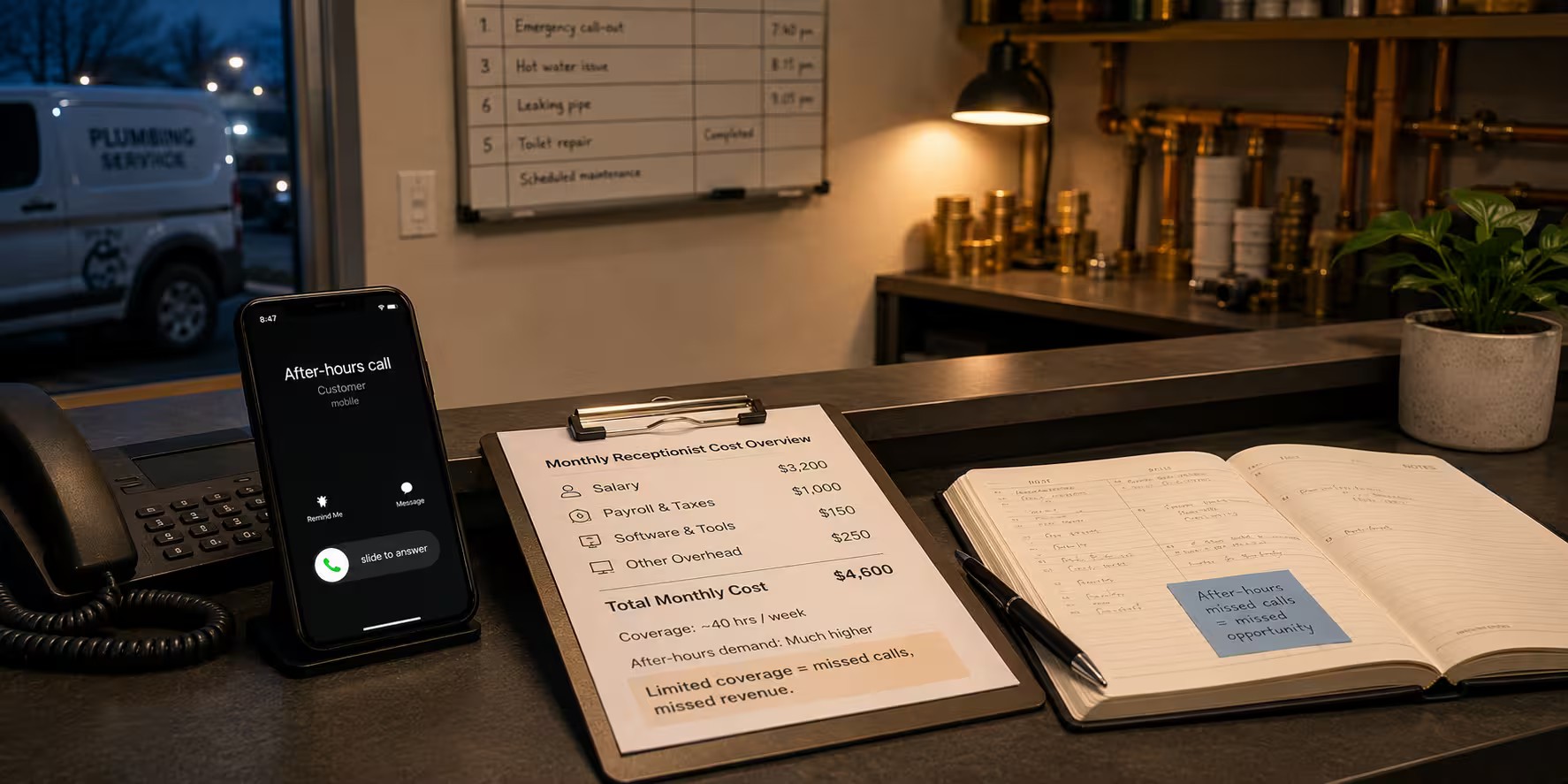
Hiring a receptionist can feel like the natural next step for a growing plumbing business.
When the phones are ringing, technicians are in the field, and customers need quick answers, having someone dedicated to call handling sounds useful. A receptionist can answer calls, collect details, schedule appointments, and give your business a more professional front-office presence.
But the real plumber receptionist cost is usually higher than the salary alone.
Once you include payroll taxes, software, phone systems, workspace, management time, sick days, turnover, and limited weekly coverage, the true cost of hiring a receptionist can become a major fixed expense for a small or mid-sized plumbing company.
This article breaks down the real cost of hiring a receptionist for a plumbing business, the coverage gap most owners overlook, and why many plumbers are now comparing traditional staffing with AI receptionist alternatives.
For business owners new to the category, this guide explains what an AI receptionist is and how it works.
The Real Cost of Hiring a Plumbing Receptionist
Many plumbing business owners start by looking only at the base wage or salary.
That is not the full cost.
A receptionist creates several direct and indirect expenses, including:
- Base salary or hourly wage
- Payroll taxes
- Workers' compensation
- Benefits or paid time off
- Office space
- Phone system costs
- CRM or scheduling software seats
- Training time
- Management time
- Hiring and replacement costs if the employee leaves
For many small plumbing businesses, this can turn a simple front-desk hire into a significant monthly overhead commitment.
Example Cost Breakdown
The numbers below are an example estimate of what a full-time receptionist or office assistant can cost a plumbing business.
| Staffing Cost Category | Example Annual Expense | Example Monthly Impact |
|---|---|---|
| Base Salary | $38,500 | $3,208 |
| Payroll Taxes and Workers' Compensation | $3,450 | $287 |
| Office Space and Utilities | $2,400 | $200 |
| Software and Phone Infrastructure | $1,200 | $100 |
| Total Estimated Cost | $45,550 | $3,795 |
Note: Actual costs vary by location, wage level, benefits, insurance, software stack, and employment structure.
In this example, the receptionist does not cost only $38,500 per year. The fully loaded cost is closer to $45,550 annually, or about $3,795 per month.
For a plumbing business with two or three trucks on the road, that fixed expense can be difficult to carry every month, especially during slower seasons.
Why Receptionist Cost Is Different for Plumbing Businesses
A plumbing business does not receive calls in a neat, predictable pattern.
Calls can arrive:
- During business hours
- After hours
- On weekends
- During storms
- During cold weather
- While technicians are already on jobs
- While the office line is already busy
- When the owner is unavailable
This creates a different problem from many other small businesses.
A receptionist may help during office hours, but plumbing demand often continues outside those hours. Customers with urgent issues usually care about one thing first: who answers fastest.
That is why the cost of a receptionist should not only be measured in salary. It should also be measured against coverage.
The 40-Hour vs 168-Hour Coverage Gap
A full-time receptionist usually works around 40 hours per week.
A full week contains 168 hours.
That means a standard full-time receptionist covers only part of the total week. Nights, weekends, holidays, sick days, vacation days, lunch breaks, and after-hours emergency calls still create coverage gaps.
For plumbing businesses, those gaps matter.
Many high-intent plumbing calls happen when the office is closed. A homeowner may discover a leak after dinner. A water heater may fail on a weekend. A sewer backup may happen late at night.
If the call goes to voicemail, the customer may not wait.
They may call another plumber immediately.
The Hidden Cost of Missed Calls
The cost of a receptionist is only one side of the equation.
The other side is the cost of missed calls.
- A missed plumbing call can mean:
- A lost emergency job
- A lost water heater replacement
- A lost drain cleaning appointment
- A lost sewer line opportunity
- A lost repeat customer
- Wasted ad spend
- Lower return from SEO and Google Business Profile traffic
For a deeper breakdown of lost call value, read our guide on the cost of a missed plumbing call.
This is especially important if your plumbing business is spending money on marketing.
If you pay for Google Ads, SEO, local service ads, direct mail, or referral campaigns, every missed call reduces the value of that marketing spend.
You may be paying to generate demand, then losing the customer at the phone line.
The Limits of a Single Human Receptionist
Even during business hours, one receptionist can only handle one live call at a time.
If two or three customers call at once, someone waits, gets sent to voicemail, or hangs up.
This can happen during:
- Monday morning rushes
- Storm-related demand spikes
- Cold weather surges
- Lunch breaks
- End-of-day scheduling rushes
- Paid ad campaigns
- Seasonal service peaks
A human receptionist can provide personal service, but the capacity is limited.
There are also normal staffing realities:
- Sick days
- Vacations
- Breaks
- Training time
- Turnover
- Hiring delays
- Performance variation
- Management overhead
For a plumbing owner, managing front-office staffing can become a job on its own.
Receptionist vs Answering Service vs AI Receptionist
Plumbing businesses usually compare three options when they need better call coverage.
| Option | Best For | Main Limitation |
|---|---|---|
| In-House Receptionist | Businesses that want a dedicated employee during office hours | High fixed cost and limited weekly coverage |
| Answering Service | Businesses that need human backup after hours or during overflow | Can be generic and may charge by usage |
| AI Receptionist | Businesses that want 24/7 answering, intake, summaries, and booking workflows | Requires proper setup and business rules |
For a more detailed breakdown of how AI receptionists compare with traditional answering services, see our AI receptionist vs answering service guide.
There is no single perfect option for every plumbing company.
Some businesses may need a full-time office assistant because they handle complex admin work beyond calls. Others may only need better phone coverage, structured intake, and appointment booking.
If the main problem is missed calls, after-hours inquiries, overflow, or inconsistent intake, an AI receptionist can often solve the problem with less fixed overhead.
How an AI Receptionist Reduces Plumbing Office Overhead
An AI receptionist helps reduce the need for every call to be handled manually.
For plumbing businesses, it can:
- Answer calls 24/7
- Handle multiple calls at once
- Ask structured intake questions
- Identify urgent plumbing issues
- Collect service address and contact details
- Answer basic service-area questions
- Book appointments when connected to a calendar
- Route emergency requests
- Send call summaries to the team
- Capture leads when staff are unavailable
This does not mean every plumbing business should eliminate human support.
Instead, AI can reduce the amount of manual call handling required from owners, technicians, dispatchers, and office staff.
It can act as the first response layer so fewer calls go unanswered.
Where Mike by Rexpt Fits
Mike by Rexpt is built for plumbing call workflows.
It is designed to help plumbing businesses handle calls such as:
- Emergency leak requests
- Burst pipe calls
- Sewer backup inquiries
- Drain cleaning appointments
- Water heater service calls
- Estimate requests
- Service-area questions
- After-hours calls
- Missed-call follow-up
Mike can answer incoming calls, collect job details, qualify the issue, identify urgency, book appointments when connected, route emergency requests based on your rules, and send structured summaries to your team.
For plumbing businesses, this can help reduce the pressure of hiring a full-time receptionist before the business is ready for that fixed monthly cost.
When Hiring a Receptionist Still Makes Sense
Hiring a receptionist can still make sense for some plumbing companies.
A human receptionist may be the better choice when the role includes:
- Complex office administration
- Invoicing support
- Permit coordination
- Customer account management
- Multi-step internal coordination
- Vendor communication
- Payroll or bookkeeping support
- In-person office duties
If the role is broader than answering calls, a human employee may still be necessary.
But if the main pain point is missed calls, after-hours coverage, appointment intake, and lead capture, it is worth comparing the cost of hiring a receptionist with the cost of using an AI receptionist or answering service.
How to Calculate Your Real Receptionist Cost
Before hiring, plumbing business owners should calculate the true monthly cost.
Use this checklist:
- Monthly salary or hourly wages
- Employer payroll taxes
- Workers' compensation
- Benefits or paid time off
- Office setup
- Phone system seat
- CRM or dispatch software seat
- Hiring time
- Training time
- Management time
- Replacement cost if the employee leaves
- Coverage gap after 5 PM and on weekends
Then compare that number with the value of the calls being missed.
A receptionist may cost several thousand dollars per month. But if missed calls are costing more than that, the business still needs a better call-handling solution.
The key is choosing the right type of coverage for your stage of growth.
Bottom Line
The real plumber receptionist cost is not just the base salary.
It includes payroll costs, software, phone systems, workspace, management time, staffing risk, and limited coverage. For many plumbing businesses, the fully loaded cost of a full-time receptionist can become a significant monthly overhead expense.
That does not mean receptionists are not valuable.
It means plumbing business owners should be clear about what problem they are trying to solve.
If the problem is broad office administration, a human receptionist or office assistant may make sense.
If the problem is missed calls, after-hours leads, overflow calls, appointment intake, and emergency routing, an AI receptionist can be a more scalable alternative.
For plumbing businesses, every unanswered call has a cost. The best solution is the one that answers quickly, captures the right details, and helps turn more calls into booked jobs.
To compare automation cost with receptionist overhead, review Rexpt pricing plans.
Frequently Asked Questions
What is the average plumber receptionist cost?

The cost depends on location, wage level, employment type, benefits, and overhead. In many cases, the fully loaded cost of a full-time receptionist can be significantly higher than base salary once payroll taxes, software, phone systems, office space, and training are included.
Is hiring a receptionist worth it for a plumbing business?

Hiring a receptionist can be worth it if your business needs broad office administration in addition to call answering. However, if your main issue is missed calls, after-hours inquiries, and appointment intake, an AI receptionist or answering service may be more cost-effective.
Why is one receptionist not enough for complete call coverage?
A full-time receptionist usually covers around 40 hours per week, while a full week has 168 hours. This leaves nights, weekends, holidays, breaks, sick days, and vacation time uncovered unless you add more staff or another answering solution.
Can an AI receptionist replace a plumbing receptionist?
An AI receptionist can handle many inbound call tasks, including answering calls, collecting customer details, qualifying the issue, booking appointments, and sending summaries. It may not replace a human employee who handles complex office administration, billing, vendor coordination, or in-person tasks.
How does an AI receptionist help plumbers reduce missed calls?
An AI receptionist answers calls when staff are busy, unavailable, or off the clock. It can collect customer details, identify urgent plumbing issues, book appointments, route emergencies, and send summaries so the team can follow up quickly.
Is Mike by Rexpt built specifically for plumbing businesses?
Yes. Mike by Rexpt is designed around plumbing call workflows, including emergency leak calls, drain cleaning requests, sewer backups, water heater service inquiries, after-hours calls, appointment booking, and structured job summaries.
On this page
- The Real Cost of Hiring a Plumbing Receptionist
- Example Cost Breakdown
- Why Receptionist Cost Is Different for Plumbing Businesses
- The 40-Hour vs 168-Hour Coverage Gap
- The Hidden Cost of Missed Calls
- The Limits of a Single Human Receptionist
- Receptionist vs Answering Service vs AI Receptionist
- How an AI Receptionist Reduces Plumbing Office Overhead
- Where Mike by Rexpt Fits
- When Hiring a Receptionist Still Makes Sense
- How to Calculate Your Real Receptionist Cost
- Bottom Line
- Frequently Asked Questions
Stop missing
customer calls.
Rexpt answers calls, qualifies leads, and books appointments 24/7.
Related Articles
Call Forwarding for Plumbing Businesses: How to Route Office, After-Hours, and Emergency Calls

After-Hours Answering for Plumbers: Options for Nights, Weekends, and Emergencies
Emergency Plumbing Call Handling: How to Triage, Route, and Escalate Urgent Calls