Comparisons
Published on Jul 2, 2026
AI Receptionist vs Answering Service: Cost, Features & Key Differences

Ryan Taylor
8 min read
Compare AI receptionist vs answering service costs, features, appointment booking, lead qualification, and use cases to choose the right option for your business.

It’s 6:30 PM on a Thursday. Your team is wrapping up for the day when a new customer calls after hours. You do not answer directly because you already have a live answering service handling calls.
The next morning, you receive the message: name, phone number, and a short note. That is all. No clear reason for the call, no appointment booked, no lead qualification, and no sense of whether the caller had a quick question, a routine booking request, or an urgent high-value need.
By the time you call back, the customer may have already contacted another business.
This is the gap many business owners miss when comparing an AI receptionist vs answering service. Both can answer calls. But they do not deliver the same outcome.
This guide breaks down the key differences between an AI receptionist and a traditional answering service, including cost, appointment booking, lead qualification, call handling quality, and which option makes more sense for different business types.
What Is a Traditional Answering Service?
A traditional answering service is a call center staffed by human agents who answer business calls on your behalf. When a call comes in, a live agent follows a script, collects caller details, takes a message, and either sends the message to your team or attempts a transfer.
Answering services have been around for decades, and for many businesses, they are better than voicemail. They can help with after-hours coverage, overflow calls, and basic message-taking.
But traditional answering services also have limitations:
- Agents usually work from a script, so anything outside the script may result in a vague response or callback request.
- Appointment booking is often limited, scripted, or available only as an add-on.
- Lead qualification depends on how detailed the script is and how well the agent follows it.
- Pricing is commonly based on minutes, call volume, or add-on services, which can make monthly costs less predictable.
- Custom business knowledge is limited compared to a system trained on your services, FAQs, booking rules, and intake process.
For many businesses, an answering service solves the problem of missed calls. But it may not fully solve the problem of missed opportunities.
What Is an AI Receptionist?
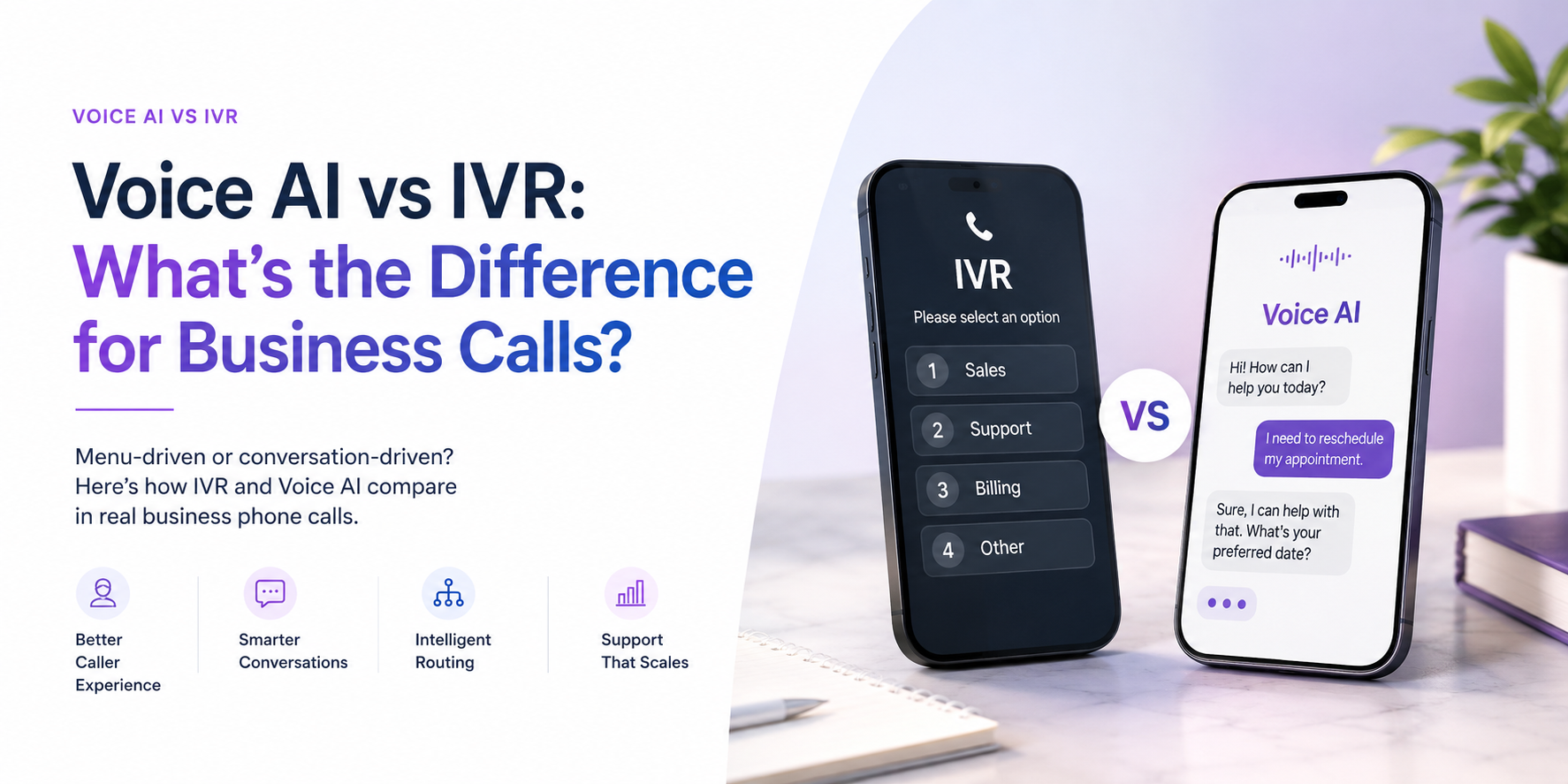
An AI receptionist is voice AI software that answers business calls, speaks with callers in natural language, and handles the full interaction — not just message-taking.
It is not a phone menu. It is not a basic chatbot reading from a fixed list. A modern AI receptionist can hold a back-and-forth conversation, ask follow-up questions, answer callers using your business information, book appointments directly into your calendar, qualify leads, and route urgent calls when needed.
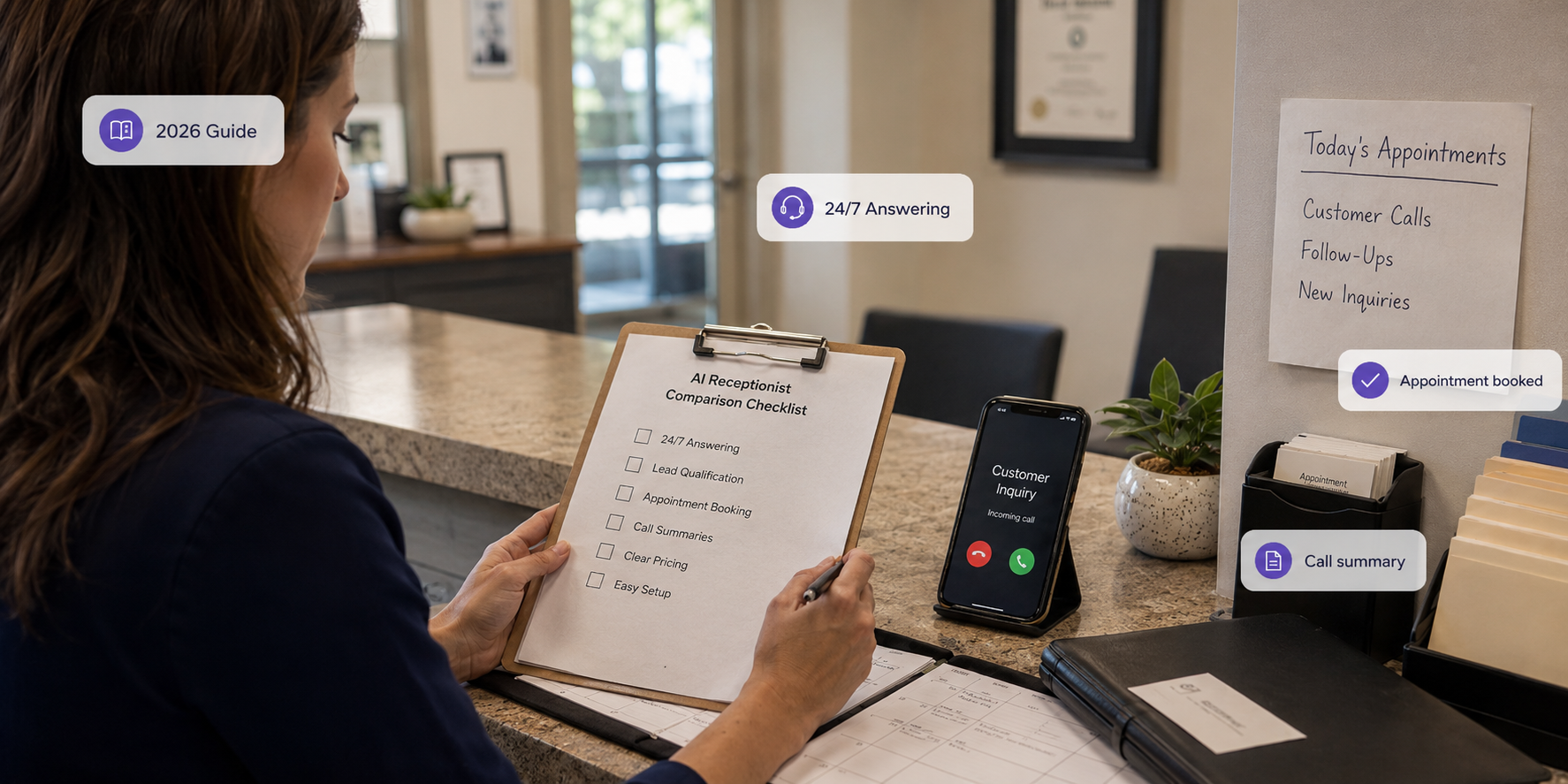
For example, when a customer calls after hours, an AI receptionist can ask what they need, collect the right details, check appointment availability, book the visit, and send your team a call summary. Instead of starting from scratch the next morning, your team already knows who called, why they called, what was booked, and what needs follow-up.
For a deeper explanation, see our complete guide on what an AI receptionist is.
AI Receptionist vs Answering Service: Side-by-Side
| Factor | Traditional Answering Service | AI Receptionist |
|---|---|---|
| Call Handling | Human agent (call center) | AI voice agent |
| Availability | 24/7 (with staffing limits) | 24/7, no limits |
| Appointment booking | ❌ Often limited or add-on | ✅ Can book directly into your calendar |
| Lead qualification | ❌ Takes message only | ✅ Asks specific qualifying questions |
| Custom business knowledge | ⚠️ Script-based, limited | ✅ Trained on your services and FAQs |
| Simultaneous calls | ❌ One at a time | ✅ Unlimited parallel calls |
| Call summaries | ❌ Basic message relay | ✅ Full summary after every call |
| Pricing model | Per-minute / per-call (variable) | Flat monthly rate |
| Average monthly cost | $300 – $1,200+ | From $99/month |
| Setup time | Days to weeks | Same day |
The Cost Difference Is Not Small
Traditional answering services charge per minute or per call. On the surface, a base plan at $150/month sounds reasonable — until a busy month hits. Industry pricing data shows that at 200 calls averaging two minutes each, a per-minute service at $2.95/minute overage can push a $325 base plan to over $1,200 in a single month. Your busiest season becomes your most expensive bill.
AI receptionists typically run on flat monthly pricing. Rexpt starts at $99/month — see our full AI receptionist pricing breakdown (https://www.rxpt.ai/blog-detail/how-much-does-an-ai-receptionist-cost) if you want the full cost comparison. Whether you take 30 calls that month or 300, the price doesn't spike.
For a service business with seasonal peaks — HVAC in summer, roofing after storms, tax firms in Q1 — that predictability matters.
Where Answering Services Still Make Sense
This is not a one-sided comparison. Traditional answering services still make sense in some situations.
High-sensitivity calls. Mental health practices, crisis lines, hospice care providers, and similar organizations may need human empathy and judgment on every call. An AI receptionist is not the right fit for every sensitive conversation.
Highly complex intake. If every call requires a long intake process with many exceptions, a trained human agent may be better for edge cases.
Specific compliance requirements. Some healthcare, legal, or regulated environments may already use answering services that meet specific compliance or documentation requirements. In those cases, switching requires more careful review.
Human-first brand experience. Some businesses simply want every caller to speak with a human, even if it costs more or creates less automation.
For these use cases, a traditional answering service may still be the better choice.
Where an AI Receptionist Wins — Clearly
It Actually Completes the Job
A traditional answering service takes a message. An AI receptionist closes the loop. It books the appointment, captures the lead details, answers the pricing question, and routes the emergency — all in the same call, at 11 PM on a Sunday.
It Qualifies Before You Call Back
When you return a call from an answering service, you're starting from scratch. When you see a summary from an AI receptionist, you already know what they need, whether it's urgent, and what their contact details are. Your follow-up is faster and more effective.
No Busy Signals During Peak Volume
Answering services handle one call at a time per agent. If three customers call simultaneously during a summer HVAC surge, two of them wait — or hang up. An AI receptionist handles unlimited simultaneous calls. Nobody waits. Nobody hangs up.
Consistent Every Single Time
A human agent has a bad day. They go off script. They misquote your pricing. They forget to ask the key question. An AI receptionist runs the same process every time — same greeting, same questions, same professionalism — at 9 AM and 2 AM.
The Math Works Faster
According to data from 1,200+ contractors across service industries, the average small service business loses $45,000–$120,000 per year to unanswered or poorly handled calls. A traditional answering service reduces that number somewhat. An AI receptionist that books, qualifies, and routes eliminates most of it — at a fraction of the cost.
Which One Is Right for Your Business?
Choose an AI receptionist if:
- You're in a trade, service, healthcare, legal, or real estate business
- You need calls handled — not just messages taken
- You want appointment booking without a human in the loop
- Your call volume fluctuates and you want predictable pricing
- You're currently using voicemail or missing after-hours calls entirely
Stick with a traditional answering service if:
- Your calls require genuine human empathy in sensitive situations
- You have compliance requirements your current answering service already meets
- Your intake process is too complex or variable for structured AI handling
And increasingly, businesses are using both: an AI receptionist for all standard calls, overflow, and after-hours — and a human service for the rare sensitive edge case.
Meet Rexpt — The AI Receptionist Built for Service Businesses
Rexpt is built for service businesses that need more than basic message-taking. It helps answer calls, qualify leads, book appointments, route urgent calls, and send structured call summaries — without relying on voicemail or a traditional answering service for every interaction.
With Rexpt, your business can:
- Answer calls 24/7, including after-hours and weekends
- Qualify leads by asking your specific intake questions
- Book appointments directly into your calendar
- Route urgent calls based on your business rules
- Send call summaries after every interaction
- Handle spam and irrelevant calls more efficiently
- Use transparent monthly plans starting at $99/month
Setup is fast and does not require engineering. You provide your business details, services, FAQs, booking preferences, and call handling rules — and Rexpt uses that information to handle calls more consistently.
No contracts. No setup fees. Cancel anytime.
Compare Rexpt plans and see how AI call handling works for your business →
Frequently Asked Questions
What is the main difference between an AI receptionist and an answering service?

A traditional answering service uses human agents to answer calls, follow a script, take messages, and transfer calls when needed. An AI receptionist uses voice AI to hold conversations, answer questions, qualify leads, book appointments, route urgent calls, and send call summaries. The main difference is outcome: answering services usually relay information, while AI receptionists can complete more of the call workflow.
Is an AI receptionist cheaper than an answering service?

An AI receptionist can be cheaper and more predictable for many businesses. Traditional answering services often charge based on minutes, call volume, transfers, appointment-setting, and add-ons. Rexpt starts at $99/month with transparent plans based on included calls and minutes, making costs easier to forecast.
Can an AI receptionist handle after-hours calls?
Yes. AI receptionists can answer after-hours, weekend, and overflow calls. They can collect caller details, answer common questions, qualify leads, book appointments, route urgent calls, and send a summary to your team.
Will an AI receptionist book appointments, or just take messages?
A capable AI receptionist can book appointments directly into your calendar during the call. This is one of the biggest differences between an AI receptionist and a basic answering service. Instead of only collecting a name and number, the AI receptionist can complete the booking process when availability and booking rules are connected.
Are there situations where a traditional answering service is better than an AI receptionist?
Yes. A traditional answering service may be better for highly sensitive calls, complex intake processes, or industries with specific compliance requirements. For routine calls, appointment booking, FAQs, lead qualification, and after-hours coverage, an AI receptionist is often more efficient and cost-predictable.
What types of businesses can use an AI receptionist?
AI receptionists are useful for service businesses that rely on phone calls, appointments, and lead capture. This includes clinics, contractors, salons, real estate offices, law firms, consultants, home service companies, agencies, and other appointment-based businesses.
On this page
- What Is a Traditional Answering Service?
- What Is an AI Receptionist?
- AI Receptionist vs Answering Service: Side-by-Side
- Where Answering Services Still Make Sense
- Where an AI Receptionist Wins — Clearly
- The Math Works Faster
- Which One Is Right for Your Business?
- Meet Rexpt — The AI Receptionist Built for Service Businesses
- Frequently Asked Questions
Stop missing
customer calls.
Rexpt answers calls, qualifies leads, and books appointments 24/7.