Comparisons
Published on Aug 24, 2026
Voice AI vs IVR: What’s the Difference for Business Phone Calls?

Rexpt Editorial Team
10 min read
IVR routes callers through predefined menus, while Voice AI lets callers explain what they need in natural language. This guide compares how both approaches handle routing, customer requests, automation, exceptions, and human escalation.
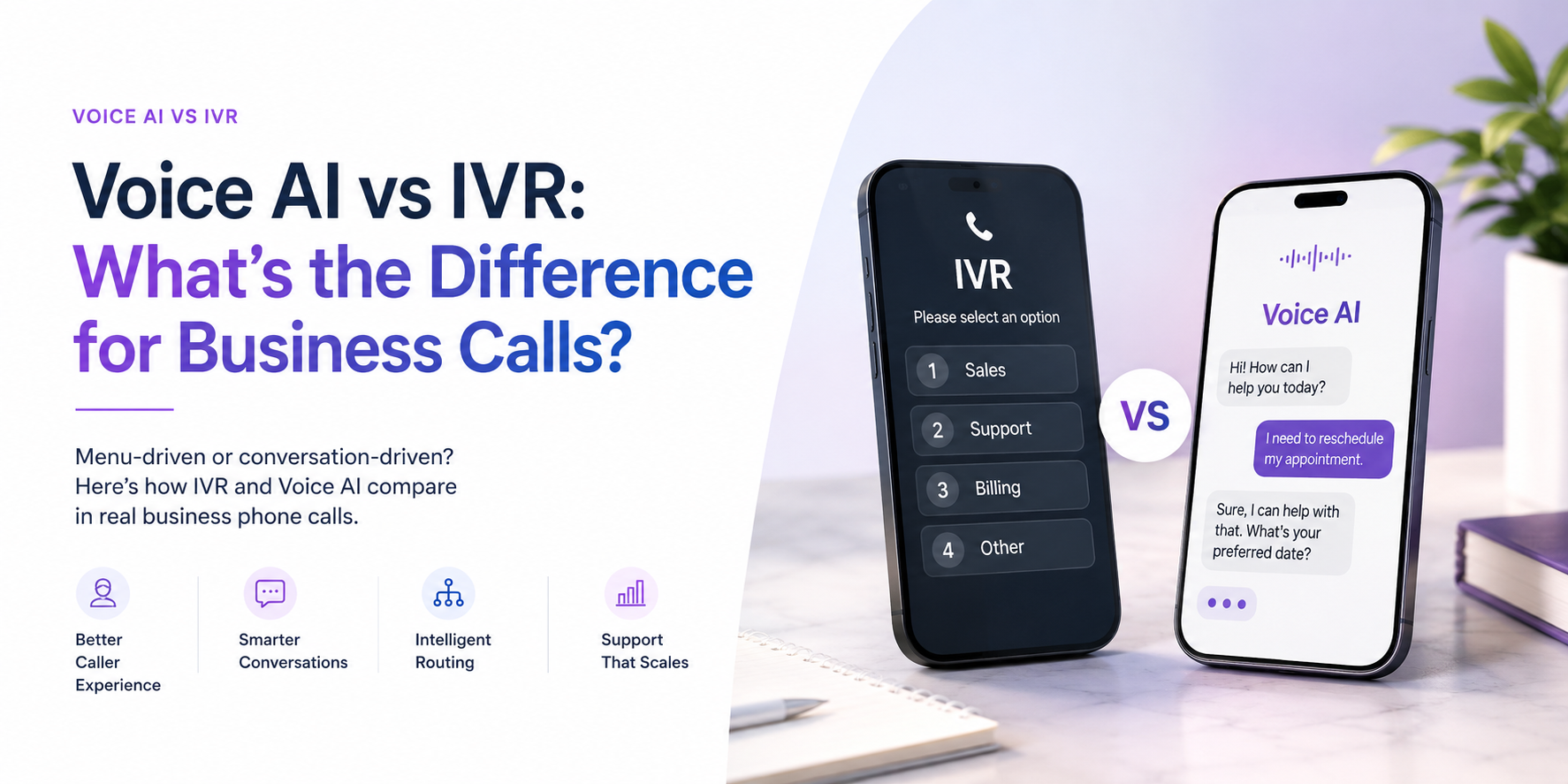
A customer calls your business and says, “I need to move my appointment to Friday, and I also wanted to check whether you’re open Saturday.”
A traditional phone menu may ask the caller to choose between appointments, business information, or another department. The caller has to decide which option best matches the reason for the call.
A Voice AI system approaches the same interaction differently. The caller can explain what they need in normal language, and the system can identify the intent, ask for the required information, and follow the appropriate business workflow.
That is the practical difference behind the Voice AI vs IVR comparison. Both technologies can automate parts of a business phone call, but they organize the interaction in fundamentally different ways.
Voice AI vs IVR: The Short Answer
IVR, or Interactive Voice Response, is an automated phone system that typically guides callers through predefined options using keypad selections or recognized speech. Voice AI uses conversational speech understanding to identify what a caller wants, maintain context through a conversation, and respond or take an appropriate next step based on the configured workflow.
Traditional IVR is primarily structured around menus and predefined paths. Voice AI is primarily structured around caller intent and conversation.
That does not mean every IVR is basic. Modern IVR platforms can use speech recognition, natural-language processing, self-service functions, and integrations. Twilio, for example, describes IVR as capable of gathering both touch-tone and spoken inputs, while newer implementations can incorporate more advanced natural-language functionality.
The boundary between the categories is therefore not absolute. The more useful comparison is between a traditional menu-driven call experience and a conversational Voice AI workflow.
What Is an IVR System?
IVR stands for Interactive Voice Response. It is the technology behind familiar phone experiences such as:
“Press 1 for sales, press 2 for support, press 3 for billing.”
The caller interacts with a predefined structure. Depending on the system, they may press numbers on the keypad, say a short response, enter account information, hear recorded information, or eventually be transferred to the appropriate person or department.
A typical IVR might work like this:
- The business answers with an automated greeting.
- The caller hears a list of options.
- The caller selects an option.
- The system may present another menu or request additional information.
- The call is routed to a department, queue, self-service function, or another destination.
IVR is particularly useful when the possible reasons for calling are predictable and can be organized into a manageable number of choices. Call routing remains one of its most common applications.
What Is Voice AI?
Voice AI allows a caller to communicate with an automated system through natural spoken language rather than navigating only through fixed menu options.
Instead of hearing:
“Press 1 for appointments.”
the caller may hear:
“How can I help you today?”
The caller can then explain the request in their own words. Depending on the system and its configuration, Voice AI can identify the caller's intent, ask follow-up questions, collect information, provide approved answers, perform connected actions, or route the conversation to a person.
For example, a caller might say:
“I need to change my appointment from Tuesday afternoon to sometime Thursday morning.”
A conversational system can potentially recognize that the caller wants to reschedule, collect any required information, work with the configured scheduling workflow, and continue the conversation without requiring the caller to translate the request into a numbered menu option.
Modern conversational AI systems can also support multi-turn interaction, connected actions, and human transfer when the automated workflow should not continue. AWS describes current conversational contact-center architectures that combine speech recognition, intent understanding, contextual responses, connected actions, and escalation to human staff.
Voice AI vs IVR: Key Differences
| Area | Traditional IVR | Voice AI |
|---|---|---|
| Caller input | Keypad or predefined spoken choices | Natural spoken language |
| Interaction structure | Menu tree | Conversation |
| Primary starting point | Which option did the caller select? | What is the caller trying to accomplish? |
| Routing | Based mainly on predefined selections | Can be based on interpreted intent and configured rules |
| Questions | Usually fixed and sequential | Can support contextual follow-up questions |
| Self-service | Effective for clearly defined transactions | Can support more conversational, multi-step workflows |
| Unexpected requests | Often requires another menu, fallback, or agent | Can attempt clarification before fallback or escalation |
| Human involvement | Usually after menu navigation | Can be introduced according to configured escalation rules |
| Best fit | Predictable, structured call flows | Variable conversations and repeatable business workflows |
The important point is not that one system has automation and the other does not. Both can automate phone interactions.
The difference is primarily how the caller communicates with that automation and how flexible the system can be when the request does not fit neatly into a predefined menu.
1. IVR Makes the Caller Choose a Path; Voice AI Identifies Intent
Traditional IVR requires the business to predict the categories callers will need.
If the menu says:
- Press 1 for sales
- Press 2 for appointments
- Press 3 for existing customers
- Press 4 for billing
the caller has to choose the closest available option.
That works well when the categories are clear. Problems arise when a caller has multiple reasons for calling, does not understand which category applies, or has a request the menu designer did not anticipate.
Voice AI changes the starting point. Instead of asking the caller to identify the correct department, the system can first ask what they need and then interpret the response.
The operational question moves from “Which button did the caller press?” to “What is the caller trying to accomplish?”
2. Routing Can Become More Contextual
IVR is very effective at deterministic routing.
A caller presses 1, and the call goes to sales. They press 2, and it goes to support. The business knows exactly how each predefined selection will behave.
Voice AI can introduce another layer by collecting context before deciding what should happen.
Consider a home-service company. Two callers may both need “service,” but one wants a quote for work next month while another describes a problem that matches the business's configured urgent-call criteria.
Sending both callers through the same generic service menu may not provide enough information for the next person receiving the call. A conversational workflow can collect details such as the type of problem, location, caller information, and relevant urgency information before applying the business's routing rules.
Human escalation still matters. Voice AI should not be treated as permission to automate situations requiring professional judgment, sensitive decision-making, or emergency response.
3. Voice AI Can Handle More Than Navigation
Traditional IVR is often associated with routing, but modern IVR systems can also support self-service tasks such as information retrieval and structured transactions. The distinction is therefore not simply “IVR routes, while AI performs tasks.”
The larger difference is flexibility.
Voice AI can combine several steps within one conversation. Depending on the system and integrations involved, a caller may be able to ask a question, provide contact information, request an appointment, clarify a preference, and receive the appropriate next step without navigating separate menu branches.
For a small business, this distinction matters because callers frequently want an outcome, not simply access to a department.
They may want to:
- Check whether the business serves their location
- Ask whether an appointment is available
- Request a quote
- Explain a service problem
- Reschedule a booking
- Provide information for a new enquiry
- Reach the appropriate employee
- Leave enough context for someone to follow up
The more conversational and multi-step the request becomes, the more limiting a rigid menu structure can become.
4. IVR and Voice AI Handle Exceptions Differently
Every phone system eventually encounters a caller who does not fit the expected path.
With a traditional IVR, that may mean selecting “other,” repeating the menu, pressing zero, or waiting to reach an employee.
Voice AI can potentially ask a clarifying question first. If the caller says something unexpected, the system may determine whether it can collect more information, provide an approved response, route the call, schedule a callback, or involve a person.
That does not mean Voice AI can safely handle every unexpected situation. A good conversational system still needs clear boundaries and fallback rules.
Businesses should define what happens when:
- The system does not understand the request
- The requested information is unavailable
- A connected system cannot complete an action
- A transfer is not answered
- The caller asks for something outside the approved workflow
- The situation requires judgment
- The caller explicitly wants a person
The quality of those fallback paths can matter just as much as the quality of the normal conversation.
5. Voice AI Requires Business Rules, Not Just Better Speech
It is easy to make the Voice AI vs IVR comparison about how natural the system sounds.
That is not the most important difference for a business.
A Voice AI system still needs to know what it is allowed to do, what information it can provide, which questions it should ask, which calls should be transferred, what counts as an escalation, and what should happen when the normal workflow cannot be completed.
A system that sounds conversational but applies the wrong business rules is not necessarily better than a simple menu that routes callers correctly.
Effective Voice AI therefore depends on accurate business information, appropriate integrations, defined workflows, testing, and ongoing review. This is also why understanding what an AI receptionist actually does is more useful than evaluating the technology only by the quality of its voice.
Where Traditional IVR Still Makes Sense
Voice AI does not make every IVR system obsolete.
Traditional IVR remains a practical option when the caller simply needs to choose between a small number of predictable destinations.
For example, a business might only need:
- Press 1 for sales
- Press 2 for support
- Press 3 for billing
If that reliably solves the routing problem, adding a conversational layer may provide limited additional value.
IVR can also make sense when a workflow is highly structured and the business deliberately wants callers to follow a fixed sequence. Predictability can be an advantage when flexibility is not required.
The important question is whether the menu is helping callers reach the correct outcome or forcing them to navigate complexity that exists mainly because of the phone system.
When Voice AI Makes More Sense
Voice AI becomes more useful as caller requests become less predictable and more conversational.
A business may benefit from Voice AI when callers frequently need to explain what they want, provide several pieces of information, ask follow-up questions, or complete a repeatable front-desk task during the conversation.
Common examples include:
- Lead capture and qualification
- Appointment requests
- Frequently asked questions
- Service-area questions
- New-customer intake
- After-hours enquiries
- Call screening
- Contextual routing
- Callback requests
- Multiple types of enquiries arriving on the same phone number
The value comes from allowing the caller to start with the actual request instead of first understanding the business's internal phone-tree structure.
This can be especially relevant outside staffed hours. An IVR can route an after-hours caller or provide recorded information, while a configured Voice AI workflow may be able to collect the request, answer routine questions, or complete an appropriate next step. Our guide to after-hours phone answering for small businesses covers the broader options.
Do You Have to Replace Your IVR to Use Voice AI?
Not necessarily.
Businesses do not always need to choose between keeping every part of the existing IVR and replacing the entire phone experience with Voice AI.
A hybrid approach can preserve structured routing where it works while introducing conversational automation for specific call types.
For example, a larger organization may retain a predictable routing layer for certain departments while using conversational AI for appointment handling, customer intake, routine questions, or another repeatable workflow.
The better architecture depends on what callers are actually trying to accomplish.
This is an important distinction because Voice AI should solve a call-handling problem, not become a technology replacement project without a clear operational reason.
Example: Home-Service Business
Imagine a plumbing or HVAC company receiving an evening call.
A traditional IVR might say:
“Press 1 for emergency service, press 2 to schedule an appointment, or press 3 for all other enquiries.”
That can work when callers clearly understand which category applies.
A conversational workflow could instead ask what is happening. The caller might explain that a pipe is leaking, provide the service address, and answer relevant intake questions. The system can then follow the company's configured rules for routine follow-up or human escalation.
A genuine threat to life or safety should follow appropriate emergency procedures rather than being treated as an ordinary automated service workflow.
The advantage here is not simply eliminating the keypad. It is collecting useful context before deciding what should happen next.
Example: Appointment-Based Business
Consider a dental office, wellness business, or other appointment-based company.
A caller might want to know whether a particular service is available, ask for a specific day, and mention that they are already an existing customer.
An IVR can route that person to appointments. A Voice AI workflow can potentially collect the necessary scheduling information and, where the relevant calendar, availability, and booking rules are configured, complete more of the interaction during the same call.
Exceptions should still have a clear path to staff.
Example: Professional-Service Business
A prospective client may call a professional-service firm and describe a situation that does not fit neatly into “sales” or “support.”
Conversational AI can help collect structured intake information and route the enquiry based on configured criteria.
That does not mean the AI should provide legal, financial, medical, or other professional judgment. In these environments, the useful role of automation is often intake and routing, while qualified professionals remain responsible for the work requiring expertise or judgment.
How to Decide Between Voice AI and IVR
Do not start by asking which technology sounds more advanced. Start with the calls.
Review a representative sample of your inbound conversations and answer the following questions:
- Why are people calling? Are most calls easily divided into three or four categories, or do callers have many different reasons for contacting you?
- Do callers only need routing, or do they need something completed? Routing to sales is different from collecting a lead, checking availability, or handling an appointment request.
- How much information needs to be collected? If the business regularly needs names, locations, service details, appointment preferences, or qualification information, a conversational workflow may be more practical.
- Do callers frequently have multiple requests? Traditional menu trees become harder to design when one caller needs several things during the same interaction.
- How often do callers reach the wrong destination? If people regularly choose the wrong menu option, intent-based routing may be worth evaluating.
- What requires a human? Identify the situations involving judgment, empathy, negotiation, professional expertise, sensitive issues, or exceptions.
- What happens after hours? Determine whether callers only need basic information or whether they are trying to complete meaningful tasks while staff are unavailable.
- What happens when automation fails? Every system needs a fallback for unanswered transfers, unavailable integrations, misunderstood requests, and unexpected caller needs.
Once those answers are clear, the technology decision becomes much easier.
Where an AI Receptionist Like Rexpt Fits
Rexpt is designed for businesses that want conversational call handling rather than relying only on a menu-driven front end.
A configured Rexpt agent can support workflows such as answering routine business questions, capturing and qualifying leads, appointment booking where the required setup is available, after-hours call handling, call routing and transfers, concurrent call handling, caller screening, and post-call summaries. Current Rexpt product information confirms support for these types of call-handling workflows.
The important word is configured.
The business still needs to define what the agent should know, which information it should collect, which calls can remain automated, which calls should reach a person, and what the fallback should be when the normal path does not work. Rexpt's content guidelines specifically treat human escalation as part of a strong workflow rather than a failure of automation.
For businesses currently relying on a long phone tree, the practical opportunity is not simply replacing “Press 1” with AI. It is redesigning the call around what the caller actually needs to accomplish.
Voice AI vs IVR: Which Should You Choose?
Choose based on the complexity of the call, not the novelty of the technology.
Traditional IVR may be enough when:
- Call reasons are predictable
- The main requirement is department routing
- A small menu handles most calls effectively
- The workflow benefits from a fixed sequence
- Callers rarely need conversational self-service
Voice AI may be worth evaluating when:
- Callers frequently explain requests in their own words
- The business needs information collected during the call
- Calls involve FAQs, qualification, scheduling, or intake
- Several caller intents may appear within one conversation
- After-hours callers need more than a recorded message
- Routing depends on context rather than a single menu selection
- Routine conversations can be automated while preserving human escalation
And in some organizations, the right answer will be both.
A well-designed phone system does not need to be purely IVR or purely Voice AI. It needs to get the caller from the initial question to the correct next step with as little unnecessary friction as possible.
The Better Question Is What the Caller Needs to Accomplish
The difference between Voice AI and IVR is not simply “new technology versus old technology.”
IVR is a structured way to automate phone navigation and predictable self-service. Voice AI creates a more conversational layer that can understand caller intent, collect context, and follow configured workflows.
Neither approach automatically produces a good customer experience.
A poorly designed IVR can frustrate callers with unnecessary menus. A poorly configured Voice AI agent can misunderstand requests or follow the wrong workflow.
Start with the call itself. Identify why customers contact you, what information needs to be collected, what can be completed automatically, when a person should take over, and what should happen when the normal process fails.
Then choose the technology that makes that workflow simpler.
Frequently Asked Questions
Is Voice AI the same as IVR?

No. Traditional IVR usually guides callers through predefined menus using keypad selections or recognized commands. Voice AI is designed around conversational interaction, allowing callers to explain what they need in natural language and continue through a configured workflow.
Can an IVR system understand spoken language?

Yes. IVR is not limited to keypad input. Some IVR systems support speech recognition and more advanced natural-language capabilities, which means the boundary between modern IVR and conversational Voice AI can overlap.
Is Voice AI better than IVR?
Not in every situation. IVR can be effective for simple, predictable routing and structured self-service. Voice AI becomes more useful when callers have varied requests, need to provide context, or want to complete multi-step tasks during the conversation.
Can Voice AI replace an existing IVR system?
It can replace some IVR workflows, but a complete replacement is not always necessary. Some businesses may keep structured IVR routing for specific call types while adding Voice AI to workflows that benefit from natural conversation, intake, or task completion.
Should a small business use IVR or Voice AI?
A simple IVR may be sufficient if most callers only need to reach one of a few departments. Voice AI is worth considering when callers frequently ask questions, provide lead information, request appointments, explain service needs, or require contextual routing.
On this page
- Voice AI vs IVR: The Short Answer
- What Is an IVR System?
- What Is Voice AI?
- Voice AI vs IVR: Key Differences
- Where Traditional IVR Still Makes Sense
- When Voice AI Makes More Sense
- Do You Have to Replace Your IVR to Use Voice AI?
- How to Decide Between Voice AI and IVR
- Where an AI Receptionist Like Rexpt Fits
- Voice AI vs IVR: Which Should You Choose?
- The Better Question Is What the Caller Needs to Accomplish
- Frequently Asked Questions
Stop missing
customer calls.
Rexpt answers calls, qualifies leads, and books appointments 24/7.