Comparisons
Published on Jul 31, 2026
Rexpt vs Vapi and Retell AI: AI Receptionist Platform vs Voice AI Infrastructure

Rexpt Editorial Team
10 min read
Rexpt, Vapi and Retell AI can all support AI phone calls, but they leave very different amounts of setup, integration and maintenance with the buyer. This guide explains which type of team each product is built for.
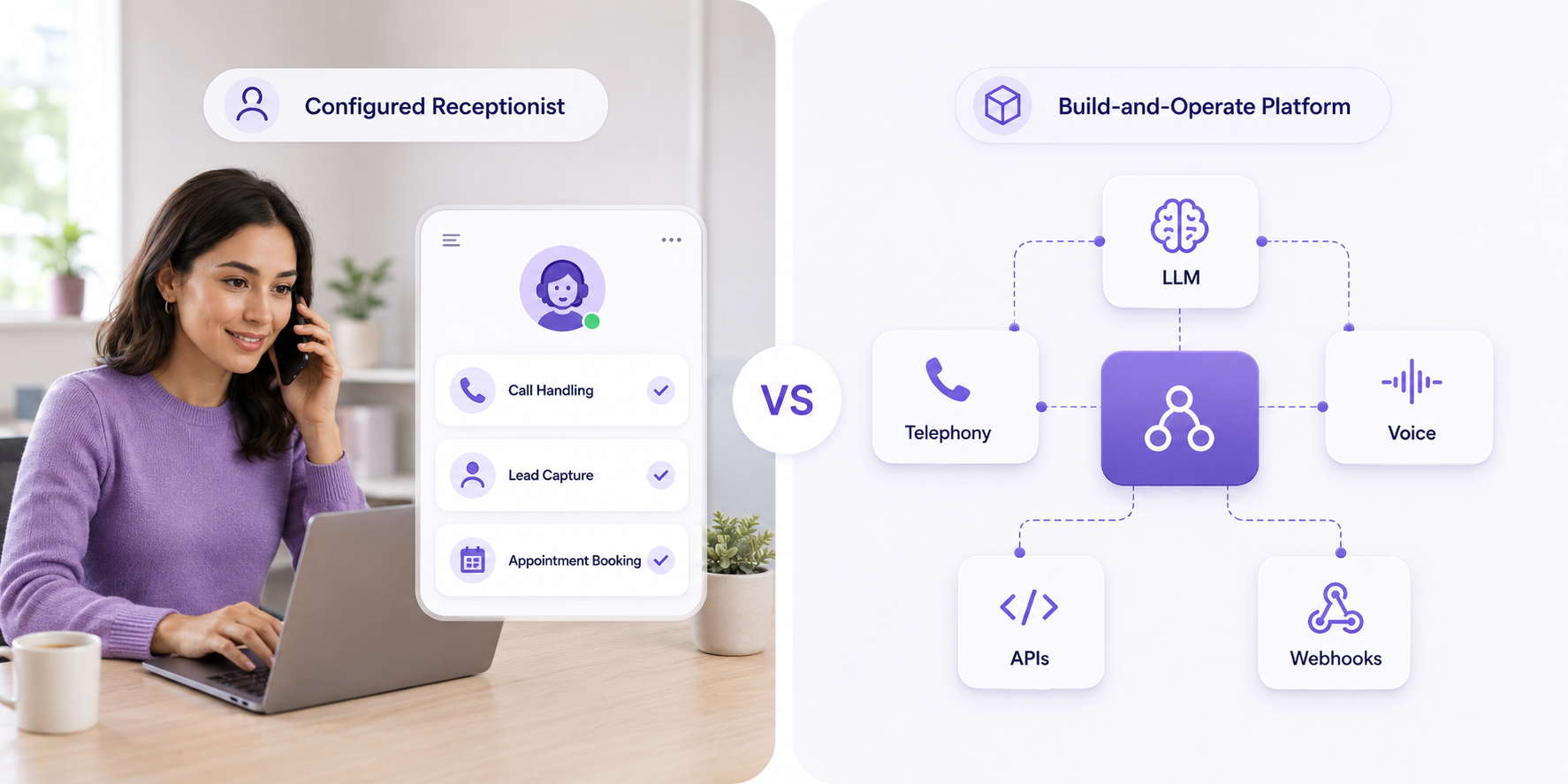
Rexpt vs Vapi vs Retell AI comparison can easily begin with the wrong assumption: that all three products are interchangeable AI receptionists and that the only question is which one has more features.
They are not interchangeable.
All three can support AI-powered phone conversations, call transfers, appointment workflows and connections to external systems. The significant difference is who is expected to assemble, configure and maintain the final business solution.
Rexpt is a configured AI receptionist product intended primarily for business owners and operational teams. Vapi is explicitly a developer platform for building voice AI applications. Retell AI sits between those categories: it offers templates, visual conversation flows and preset functions, but it remains a platform for creating, deploying and operating voice agents rather than a completed SMB front-desk product.
Quick answer: Choose Rexpt when the requirement is an operational AI receptionist without assembling the underlying voice stack. Choose Vapi when a technical team wants maximum architectural control. Consider Retell when the team wants a more managed voice-agent builder but is still prepared to design, integrate, test and maintain the agent.
For a separate overview of Rexpt’s features, founders and target businesses, read What Is Rexpt AI?.
The Core Difference: Configuring a Product vs Building a System
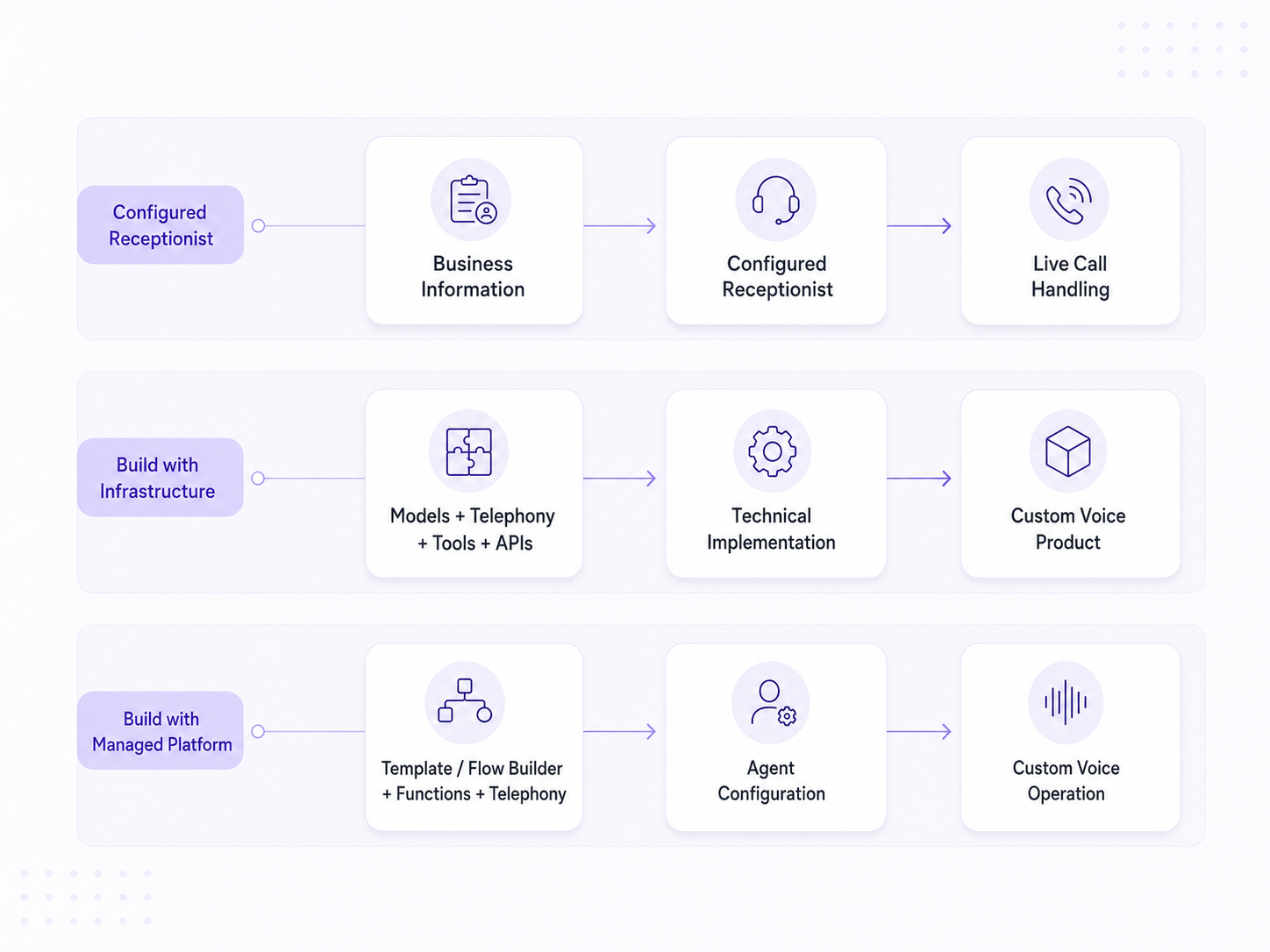
Rexpt, Vapi and Retell AI operate at different levels of abstraction.
With Rexpt, the business starts with a defined use case: answering customer calls, collecting lead details, booking appointments, routing calls and maintaining usable call records. The standard configuration process focuses on business information, services, operating hours, qualification questions, calendars and escalation rules.
With Vapi, the customer starts with voice-agent building blocks. The team can select models, voices, phone-number providers, tools, server integrations and custom application logic. Vapi manages difficult real-time voice infrastructure, but the buyer still defines what the final product should do and how it connects to the rest of the business.
Retell provides more assembled functionality than a purely modular API. It includes agent templates, visual conversation flows, preset functions, simulation testing, analytics and managed phone numbers. However, the customer still owns the agent design, external integrations, testing strategy and ongoing operational logic.
Rexpt vs Vapi vs Retell AI at a Glance
| Comparison area | Rexpt | Vapi | Retell AI |
|---|---|---|---|
| Primary product type | Configured AI receptionist product | Developer-first voice AI platform | Configurable voice-agent platform |
| Typical buyer | SMB owner, office manager or operations team | Developer, product team or voice AI agency | Technical, automation, call-center or operations team |
| Standard setup | Add business information, rules, calendar and routing requirements | Configure agent, models, tools, telephony and integrations | Select template or flow, configure agent, functions, telephony and testing |
| Coding requirement | None for standard setup; custom work may require Rexpt support | Basic agents can be created in the dashboard; advanced workflows often require APIs, webhooks or code | Low-code options are available; custom systems commonly require functions, APIs or webhooks |
| Phone numbers | Subscription plans include a VoIP number; existing numbers can be forwarded | Free US numbers are available within stated limits; external numbers can be imported | US and Canadian numbers can be purchased or custom telephony can be imported |
| CRM approach | Built-in lead and call-management features plus supported CRM connections | External CRM connection through tools, integrations or custom APIs | External CRM integrations, functions and webhooks |
| Appointment workflows | Built-in calendar and appointment-management functionality | Created through tools, integrations and custom logic | Preset availability and calendar-booking functions are available |
| Concurrent calls | Parallel call handling; capacity depends on plan and configuration | 10 concurrent calls included by default; more can be reserved | 20 concurrent calls on pay-as-you-go; additional capacity available |
| Emergency handling | Urgency detection and configured transfer or escalation workflows | The implementation team must define the classification and action logic | The implementation team configures flow conditions, functions and transfers |
| SMS | SMS alerts and notifications where supported and configured | SMS tool and messaging integrations are available | SMS nodes and functions are available, subject to number and compliance requirements |
| Custom flexibility | Focused on business receptionist workflows; custom integrations are available | Highest control over models, providers, logic and application architecture | High configurability through visual flows, functions, APIs and integrations |
| Ongoing maintenance | Primarily business information, rules, integrations and performance review | Technical stack, providers, integrations, tools, testing and monitoring | Agent flows, prompts, integrations, testing, analysis and monitoring |
The table reflects the products’ documented architecture and current standard limits. Exact capacity, integrations and commercial terms can vary by plan and deployment.
1. Intended Buyer
Rexpt: Businesses That Need a Receptionist Workflow
Rexpt is designed for businesses that want calls handled according to practical operating rules without first building a voice application.
The typical buyer is not choosing a speech-to-text model, hosting a webhook server or designing an agent orchestration layer. The buyer is deciding:
- What information should be collected?
- Which callers should be qualified?
- When should an appointment be booked?
- Which calls should be transferred?
- What should happen outside business hours?
- When should a person take over?
This approach is suited to call-dependent SMBs such as plumbing, HVAC, healthcare, real estate, fitness and professional-service businesses.
Vapi: Developers and Product Teams
Vapi describes itself as a developer platform for building voice AI agents. Its modular architecture allows teams to choose models, voices, telephony providers, custom tools and external data sources.
That flexibility is valuable when a company is creating:
- A custom voice AI product
- A white-label voice service
- A specialized outbound or inbound application
- A multi-agent system
- A voice layer inside an existing software product
- A workflow that requires proprietary backend logic
Vapi does provide a dashboard and a basic agent can be launched without coding. However, its strongest value appears when a technical team uses its APIs, tools, webhooks and provider controls to build something specific.
Retell AI: Teams That Want a Configurable Voice-Agent Platform
Retell is not simply a raw API.
Its official platform includes templates, a visual agent framework, preset functions, simulation testing, analytics, managed telephony and external integrations. A team can therefore build a standard agent with less technical assembly than a fully modular implementation.
The distinction is that Retell still asks the buyer to design and operate the voice agent. The team must configure conversation logic, functions, escalation paths, integrations, testing and performance monitoring. This makes it a stronger fit for technical operations teams, automation specialists, call centers and companies building custom call automation.
2. Setup and Coding Requirements
The statement that Vapi and Retell always require coding would be inaccurate.
Both platforms provide dashboards and tools that can create basic agents without writing a complete application. The difference becomes clearer once the business requires custom actions.
Vapi’s advanced capabilities include custom tools, code tools, server-based functions, APIs, external model providers and webhooks. Its documentation notes that advanced function calling can require a server URL that receives and responds to platform messages.
Retell provides preset tools for call transfers, availability checking, calendar booking and SMS. It also supports custom functions that call external APIs, webhooks for call events and a JavaScript code tool for lightweight logic. Authenticated or production write operations generally require a custom backend function.
Rexpt removes most of this assembly from its standard SMB setup. The business configures the receptionist rather than selecting and connecting the underlying voice components. Custom integrations or enterprise workflows can still require scoped development, but that work is separate from the normal self-service receptionist setup.
3. Phone-Number Provisioning and Telephony
All three products support live telephone calls, but their telephony models differ.
Rexpt subscription plans include a VoIP number, and businesses can forward an existing number to the configured receptionist. Its PAYG and trial arrangements follow separate phone-number rules, so businesses should verify the current plan before deployment.
Vapi offers free US national phone numbers within account limits. Teams can also import numbers from providers such as Twilio, Telnyx, Vonage or another supported bring-your-own telephony setup. This provides considerable telephony control, but external provider accounts and credentials may be required.
Retell allows customers to purchase US or Canadian numbers directly from the platform. It also supports imported phone numbers and custom telephony for companies that want to retain an existing provider or SIP architecture.
4. Built-In CRM and Lead Management
“CRM” can mean two different things in a voice AI comparison:
- A native interface for storing and reviewing leads, calls and appointments
- An integration with an external CRM such as HubSpot, Zoho or Salesforce
Rexpt provides built-in call, lead and appointment-management functionality and can connect with supported external CRMs. This allows an SMB to begin with a usable operational interface rather than building a separate lead database first.
Vapi’s official documentation emphasizes tools and integrations that update external CRM records. For example, Make and GoHighLevel workflows can be triggered during calls, and custom tools can connect the voice agent to a company’s own systems. Vapi should therefore be viewed as the voice and orchestration layer rather than a general-purpose built-in SMB CRM.
Retell similarly emphasizes CRM integrations, custom functions and webhooks. Its HubSpot integration can trigger calls from HubSpot workflows, while call events and results can be sent to external systems. Its platform dashboard handles calls and analysis, but the business’s main customer record will generally remain in the connected CRM.
5. Appointment Workflows
All three products can support appointment booking, but “supports booking” does not mean the setup is identical.
Rexpt includes calendar and appointment-management functionality as part of its receptionist product. The business configures availability, booking rules and supported integrations around its operating process.
Vapi can create appointment workflows through tools, integrations and custom business logic. The implementation team is responsible for defining availability checks, booking actions, confirmation messages, rescheduling rules and failure handling.
Retell includes preset functions for checking availability and booking appointments through Cal.com. The team must still configure credentials, event types, function descriptions and agent instructions. More specialized calendars or scheduling policies may require custom functions.
6. Concurrent Call Handling
Concurrent calling is one area where infrastructure platforms expose more explicit capacity controls.
Vapi currently includes 10 concurrent call slots by default. Additional capacity can be reserved through paid or custom arrangements.
Retell’s pay-as-you-go plan includes 20 concurrent calls. Additional concurrency can be purchased, and enterprise deployments can use higher custom limits. Retell also provides a burst option for temporary traffic above the standard quota.
Rexpt supports parallel call answering, but the correct capacity should be confirmed for the selected plan and deployment rather than presented as unlimited in every configuration. For an SMB buyer, the operational question is generally whether simultaneous callers are handled without a busy signal; for a developer platform buyer, concurrency is also an infrastructure and cost-planning variable.
7. Emergency Qualification and Escalation
Emergency qualification is not simply a voice-quality feature. It is a business workflow.
A plumbing company may need the agent to distinguish a burst pipe from a quotation request. A medical practice may need a clear boundary between routine scheduling and situations that should be redirected to emergency services. Every industry requires different questions, restrictions and escalation rules.
Rexpt’s feature set includes urgency and sentiment analysis, call screening and warm-transfer workflows. These functions still need accurate business rules and should not be treated as a substitute for professional judgment or emergency services.
Vapi and Retell can both implement emergency or high-priority classification. Vapi can use prompts, structured outputs, tools and transfer functions. Retell can use conversation-flow conditions, custom functions and transfer tools. In both cases, the implementation team is responsible for designing and testing the logic rather than assuming the platform provides an industry-ready emergency workflow by default.
8. SMS Dispatch and Notifications
Rexpt’s official feature material lists email and SMS updates for meetings, calls and reminders. A workflow can therefore notify the business or support follow-up, but automatic technician dispatch should only be claimed when the relevant workflow and integration have been configured.
Vapi provides an SMS tool that an agent can invoke during a call. It also supports messaging integrations and inbound SMS under specific number and geographic conditions. Custom notification or dispatch logic can be connected through external workflows and APIs.
Retell provides SMS nodes and functions that can send a message to the caller or another number. SMS capability depends on the number, geography and applicable A2P approval requirements. Retell also supports two-way SMS configurations for eligible numbers.
9. Custom Development Flexibility
Vapi provides the greatest low-level flexibility of the three products.
Teams can choose model providers, voices, telephony, custom LLMs, tools, server logic and multi-agent architecture. This is valuable when the voice agent is part of a proprietary product or must meet unusual technical requirements. The trade-off is a larger design and maintenance surface.
Retell also offers substantial customization through conversation flows, APIs, custom functions, code tools, webhooks and external telephony. Compared with Vapi, it provides more preset operational features and a more managed agent-building environment. It still gives the buyer significantly more implementation responsibility than a packaged receptionist product.
Rexpt intentionally limits the amount of technical assembly required for common receptionist use cases. That makes it less suitable when a company wants complete control over every voice, model and orchestration component. It makes it more suitable when the buyer wants call handling, lead capture, appointments and routing without first creating a voice AI product. Custom integrations and enterprise workflows remain available through scoped development.
10. Ongoing Maintenance
The initial setup is only part of the decision.
A Vapi implementation may require continued management of provider keys, model choices, prompts, tools, server endpoints, telephony, costs, webhooks, tests and monitoring.
A Retell implementation can reduce some of that infrastructure work through its visual builder, preset functions and managed stack. The team still needs to maintain conversation flows, integrations, agent instructions, testing and performance analysis.
A standard Rexpt deployment moves most technical platform maintenance to the product provider. The business still needs to maintain accurate services, hours, appointment rules, routing destinations, qualification questions and escalation policies.
This maintenance comparison is an operational inference from how each product documents its setup, integration and deployment model.
How Their Pricing Models Differ
Direct per-minute comparisons can be misleading because the products package different responsibilities.
Vapi’s current Build pricing lists a platform hosting charge of $0.05 per call minute, with model-provider costs passed through separately. Ten concurrent calls are included, with additional capacity charged separately.
Retell currently lists voice-agent pricing from $0.07 to $0.31 per minute, depending on models and options. Its pricing also separates telephony, add-ons, phone numbers, SMS and additional concurrency where applicable.
Rexpt uses packaged business plans and PAYG options that combine call-handling features, minutes and plan-specific functionality. The relevant comparison is therefore not only the per-minute price. It is the total cost of ownership, including implementation time, external services, engineering, testing and ongoing maintenance.
Current prices and plan terms should always be checked on each company’s official pricing page before making a purchase decision.
Which Option Should You Choose?
Choose Rexpt when:
- You need an operational AI receptionist rather than a voice AI development project.
- The buyer is an SMB owner, office manager or operations team.
- Lead capture, appointment handling and call routing should be available in one business-facing product.
- You want to minimize coding, infrastructure decisions and ongoing technical maintenance.
- Your workflow fits supported receptionist and integration patterns.
Choose Vapi when:
- You are building a custom voice application or product.
- Your team wants control over models, voices, telephony and backend logic.
- You have developers who can manage APIs, tools, webhooks and provider services.
- Custom architecture is more important than a packaged receptionist workflow.
- You may need proprietary multi-agent or deeply integrated behavior.
Choose Retell AI when:
- You want a configurable voice-agent platform with visual flows and preset functions.
- You need more control than a packaged receptionist provides.
- Your team can own agent design, integrations, testing and monitoring.
- You want managed telephony, simulation testing and operational analytics.
- You need custom inbound, outbound or call-center automation.
Final Verdict
Rexpt is not a less advanced version of Vapi or Retell AI.
It is a different type of product.
Vapi provides developer-first infrastructure and modular control for teams building voice applications. Retell provides a more managed voice-agent platform with visual tooling and preset functions, while still leaving significant implementation responsibility with the buyer.
Rexpt packages common business call-handling requirements into a configured receptionist product for SMB operators.
The right choice depends on what the buyer is trying to obtain:
- A working business receptionist
- A configurable voice-agent operation
- Or the building blocks for a custom voice product
No single option is universally superior. The strongest choice is the one that matches the organization’s technical resources, required flexibility, call workflows and willingness to maintain the resulting system.
Explore Rexpt’s AI receptionist features or review the latest Rexpt pricing options.
Frequently Asked Questions
Is Rexpt a direct replacement for Vapi or Retell AI?

Not in every use case. Rexpt can be an alternative when the buyer needs a configured AI receptionist. It is not a like-for-like replacement for teams using Vapi or Retell to build proprietary voice applications.
Does Vapi require coding?

A basic Vapi agent can be created through its dashboard without coding. Advanced tools, authenticated integrations, custom application logic and server-side workflows commonly require APIs, webhooks or development work.
Is Retell AI a no-code platform?
Retell provides visual flows, templates and preset functions that reduce coding requirements. Custom integrations and specialized business logic may still require functions, APIs, webhooks or backend development.
Can all three products book appointments?
Yes, but the implementation differs. Rexpt includes appointment-management functionality, Vapi connects booking through tools and integrations, and Retell provides preset calendar functions alongside custom options.
Can all three handle multiple calls at once?
Yes, but capacity and commercial limits differ. Vapi currently includes 10 concurrent calls by default, Retell includes 20 on pay-as-you-go, and Rexpt’s parallel-call capacity depends on the selected plan and configuration.
Which product offers the most customization?
Vapi generally provides the greatest control over the voice stack and application architecture. Retell provides substantial customization with more preset tooling. Rexpt is more opinionated because it is optimized for operational receptionist workflows rather than unrestricted voice-product development.
Which option requires the least ongoing technical maintenance?
For a standard SMB receptionist deployment, Rexpt generally leaves the least technical infrastructure with the buyer. Vapi leaves the most architectural control—and therefore more technical ownership—with the implementation team. Retell sits between those approaches.
On this page
- The Core Difference: Configuring a Product vs Building a System
- Rexpt vs Vapi vs Retell AI at a Glance
- 1. Intended Buyer
- 2. Setup and Coding Requirements
- 3. Phone-Number Provisioning and Telephony
- 4. Built-In CRM and Lead Management
- 5. Appointment Workflows
- 6. Concurrent Call Handling
- 7. Emergency Qualification and Escalation
- 8. SMS Dispatch and Notifications
- 9. Custom Development Flexibility
- 10. Ongoing Maintenance
- How Their Pricing Models Differ
- Which Option Should You Choose?
- Final Verdict
- Frequently Asked Questions
Stop missing
customer calls.
Rexpt answers calls, qualifies leads, and books appointments 24/7.