Comparisons
Published on Jul 9, 2026
AI Receptionist vs Human Receptionist: Cost, Coverage & Key Differences

Ryan Taylor
10 min read
Compare AI receptionists and human receptionists on cost, availability, call handling, lead qualification, appointment booking, and the best fit for different business types.
It is 7:43 PM on a Tuesday.
You finished your last appointment an hour ago, cleaned up, and finally sat down for dinner. Your phone rings. Unknown number. You let it go to voicemail because you are tired and plan to deal with it tomorrow.
Tomorrow comes.
No voicemail.
They did not leave one.
That was a new customer. Gone.
If you run an HVAC company, dental practice, law firm, salon, real estate office, clinic, or home service business, this can happen more often than you realize. Most businesses cannot afford to have someone answer the phone every hour of every day. But they also cannot afford to keep losing leads because no one picked up.
That is where the AI receptionist vs human receptionist comparison becomes practical.
This is not just a question of technology. It is a question of cost, availability, consistency, customer experience, and revenue protection.
This guide breaks down the real difference between an AI receptionist and a human receptionist, where each option works best, and how to decide which one fits your business.
What Is an AI Receptionist?
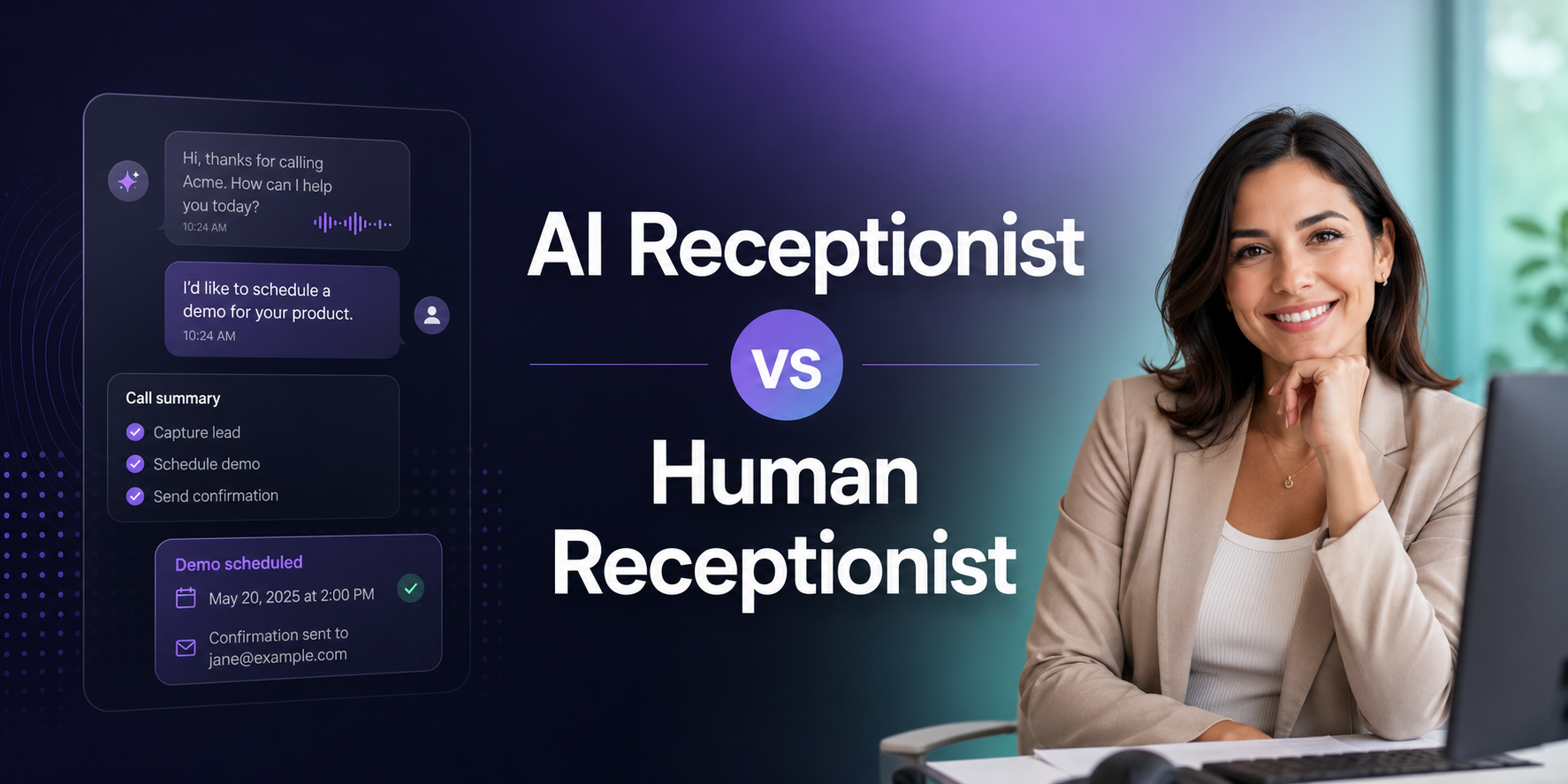
An AI receptionist is software that answers business calls, speaks with callers in natural language, answers common questions, qualifies leads, books appointments, routes urgent calls, and sends call summaries to your team.
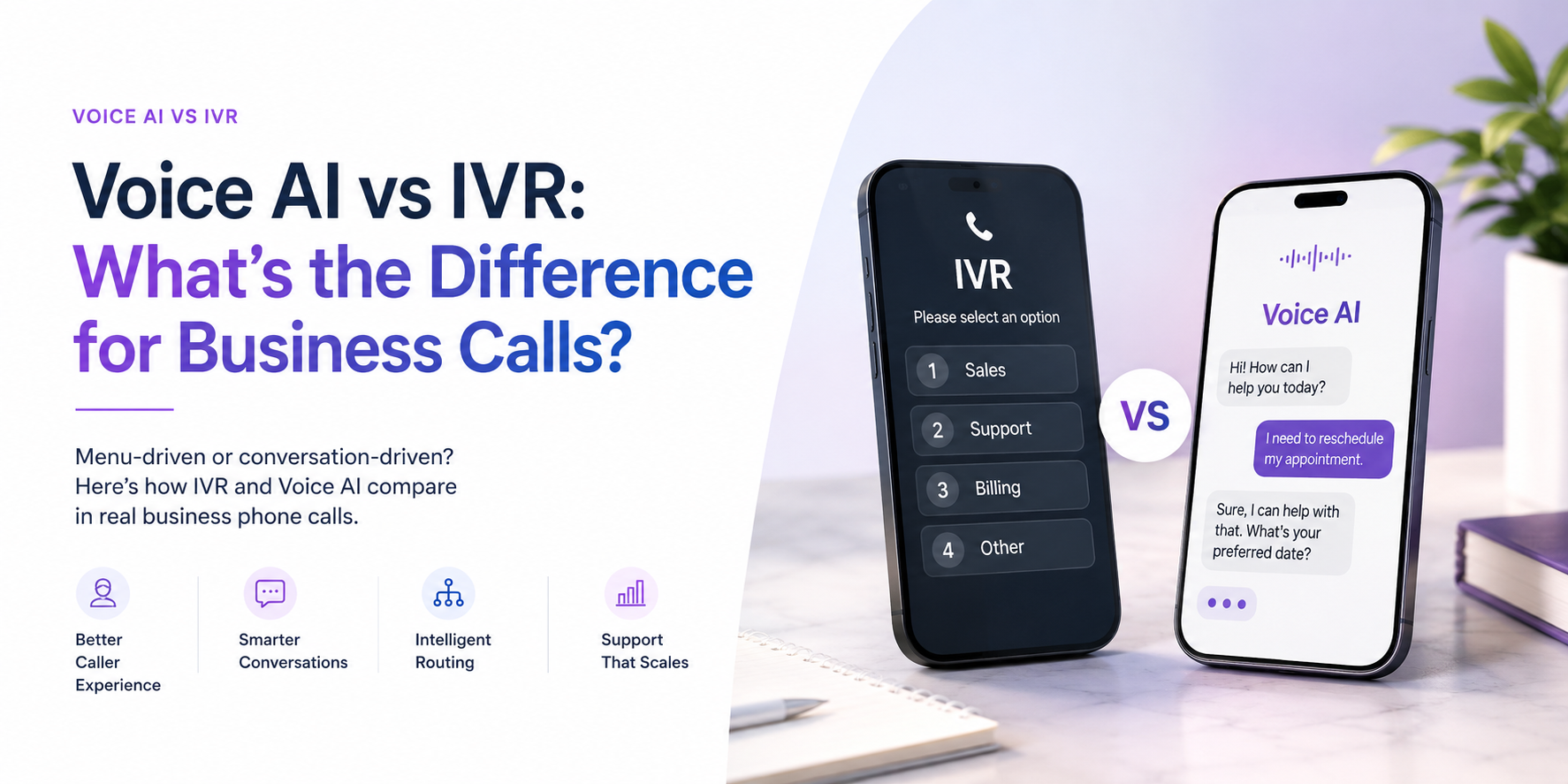
It is not a phone menu.
It is not voicemail.
It is not a basic “press 1 for sales” system.
A modern AI receptionist can hold a back-and-forth conversation with callers. It can understand why someone is calling, ask follow-up questions, collect the right details, and take action based on your business rules.
For example, if a new customer calls after hours, an AI receptionist can ask what they need, collect their name and contact details, identify whether the request is urgent, book an appointment if your calendar is connected, or route the call to the right person.
For a deeper explanation, see our guide on what an AI receptionist is.
What Does a Human Receptionist Do?
A human receptionist answers calls, greets visitors, schedules appointments, takes messages, handles basic admin work, and often acts as the first impression of your business.
A good human receptionist can be extremely valuable. They can read tone, calm frustrated callers, recognize repeat customers, handle walk-ins, and manage unusual situations with judgment.
But a human receptionist also has practical limits.
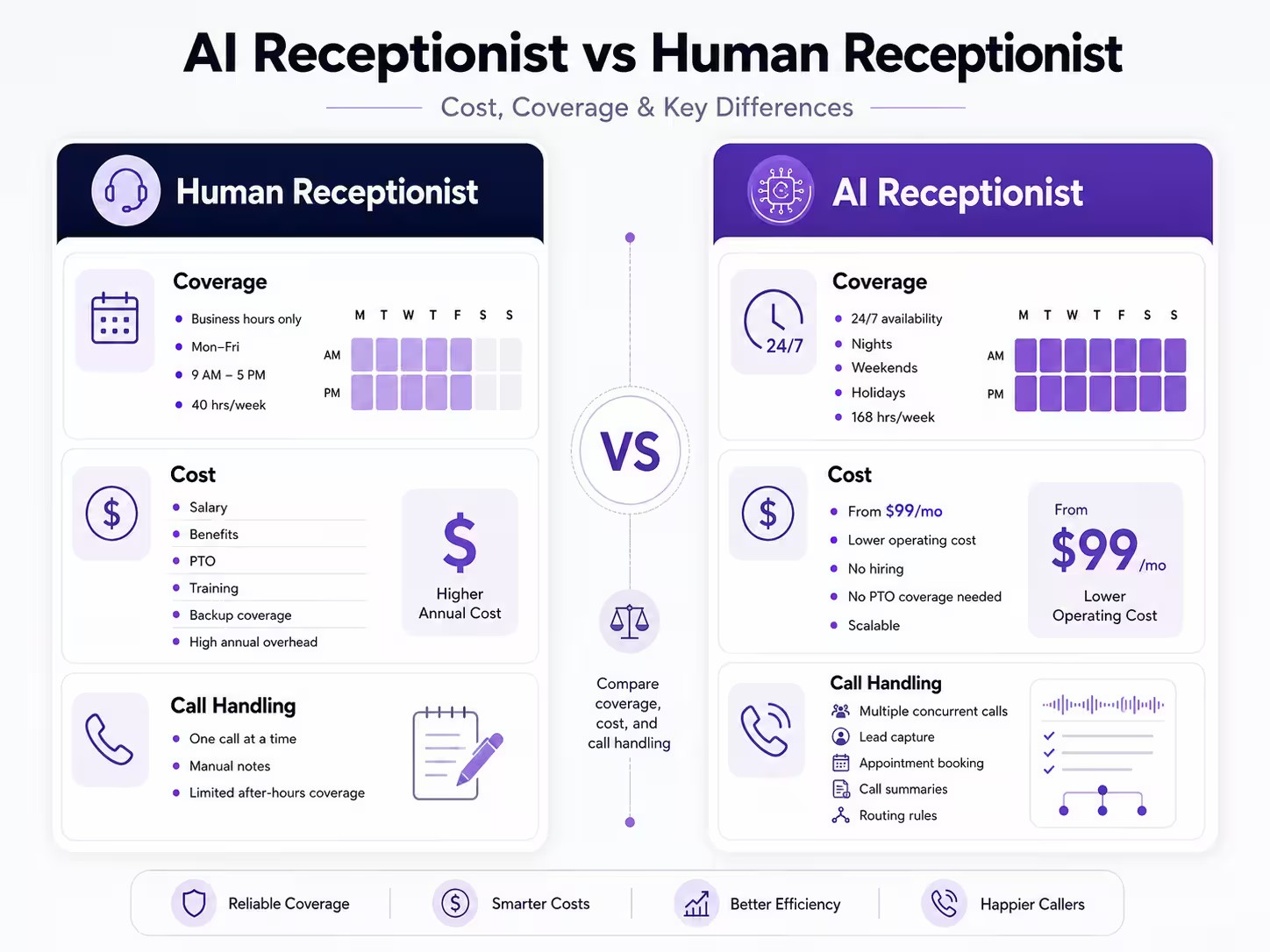
They work set hours. They take breaks. They get sick. They go on vacation. They can usually answer only one call at a time. And for many businesses, the real cost is much higher than the base salary.
That is why the better question is not simply:
“Should we use AI or hire a human?”
The better question is:
“Which calls need human judgment, and which calls can be handled faster and more consistently with AI?”
The Real Cost: AI Receptionist vs Human Receptionist
Cost is one of the biggest differences between an AI receptionist and a human receptionist.
According to the U.S. Bureau of Labor Statistics, the median annual pay for receptionists was $37,230 in 2024. That is only base pay. Once you include payroll taxes, benefits, paid time off, hiring time, training, turnover, and backup coverage, the real annual cost of a full-time receptionist can be much higher.
For many businesses, a full-time receptionist can become a $45,000–$65,000 annual expense.
And that usually covers only business hours.
An AI receptionist costs significantly less and can provide 24/7 call coverage. Rexpt AI Receptionist starts at $99/month, with plans based on included calls, minutes, and features. For a full breakdown, see our AI receptionist pricing guide or view Rexpt pricing plans.
AI Receptionist vs Human Receptionist Cost Comparison
| Factor | Human Receptionist | AI Receptionist |
|---|---|---|
| Monthly cost | Often $3,000–$5,400+ fully loaded | Starts at $99/month |
| Coverage | Usually business hours | 24/7 call answering |
| Sick days / vacation | Requires backup coverage | No sick days or vacation |
| Simultaneous calls | Usually one call at a time | Handles multiple concurrent calls |
| Appointment booking | Yes | Yes, with calendar setup |
| Lead qualification | Depends on training and consistency | Follows the same intake process every time |
| Call summaries | Manual notes | Automatic summaries |
| Emergency routing | Limited unless staffed after hours | Can route based on your rules |
| Setup time | Hiring and training can take weeks | Can be set up quickly |
The cost difference is not only salary versus software. It is the difference between limited coverage and always-on coverage.
Where Human Receptionists Still Win
AI receptionists are useful, but they do not make human receptionists irrelevant. There are still situations where a human receptionist is the better fit.
Complex Emotional Situations
Some calls require empathy, patience, and judgment.
A patient calling a dental office in pain, a legal client dealing with a stressful situation, or a customer making a serious complaint may need a calm human voice.
An AI receptionist can collect details and route the call, but sensitive conversations may still need human involvement.
Walk-Ins and Physical Front Desk Work
A human receptionist can greet visitors, check people in, hand over paperwork, manage waiting rooms, and handle physical documents.
AI cannot run a physical front desk. It handles calls and digital workflows.
If your business depends heavily on in-person reception, a human receptionist still has a clear role.
Long-Term Relationship Building
Some businesses rely on repeat customers who value personal familiarity.
A good receptionist may remember names, preferences, family details, appointment history, and past conversations. That kind of relationship-building still belongs to humans.
Unusual or Sensitive Edge Cases
Some calls do not fit a standard workflow.
A complaint escalation, unusual legal question, medical concern, billing dispute, or highly specific customer issue may require human judgment.
In these cases, the AI receptionist should not replace the human. It should capture details, summarize the call, and route it correctly.
Where AI Receptionists Win
AI receptionists win in areas where human coverage is expensive, limited, or inconsistent.
1. After-Hours Coverage
A human receptionist usually works fixed hours.
Customers do not.
A homeowner may call a plumber at 11 PM. A patient may call a dental office after work. A real estate lead may call on Sunday. A salon customer may try to book an appointment after closing.
If nobody answers, many callers move on.
An AI receptionist answers after-hours calls immediately. It can capture the lead, answer common questions, book the appointment, or route urgent calls based on your rules.
This is one of the strongest advantages of an AI receptionist: it covers the hours your team cannot cover affordably.
2. Lead Qualification
A human receptionist can qualify leads, but only if they are trained well and follow the process consistently.
An AI receptionist can ask the same required questions every time.
For an HVAC company, it can ask whether the caller needs repair, maintenance, or installation.
For a law firm, it can collect case type, contact details, and urgency.
For a salon, it can ask which service the caller wants and when they are available.
For a clinic, it can collect basic appointment details and route the request correctly.
That means your team gets better information before calling back.
3. Consistency
Human receptionists have good days and bad days.
They can forget to ask a question. They can mishear details. They can write incomplete notes. They can handle similar calls differently depending on workload, stress, or training.
An AI receptionist follows the same intake process every time.
Same greeting.
Same required questions.
Same routing rules.
Same summary format.
For businesses that rely on repeatable workflows, that consistency matters.
4. Multiple Calls at the Same Time
A human receptionist can usually handle one call at a time.
If two or three people call at once, someone waits, goes to voicemail, or hangs up.
An AI receptionist can handle multiple concurrent calls, which is useful during peak demand, seasonal rushes, promotions, emergencies, or busy office hours.
This does not mean every business needs unlimited call capacity. It means your call coverage is not limited by one person sitting at a desk.
5. Speed to Deploy
Hiring a receptionist takes time.
You need to post the job, review applications, interview candidates, onboard the hire, train them, monitor performance, and create backup coverage.
An AI receptionist can be deployed much faster.
With Rexpt, you provide your business details, services, FAQs, availability, and call handling rules. The system uses that information to answer calls and follow your process.
No engineering team is required.
Who Should Use an AI Receptionist?
The AI receptionist vs human receptionist decision depends on your business model, call volume, budget, and customer experience needs.
An AI Receptionist Is the Right Fit If:
- You miss calls during jobs, meetings, appointments, or after hours
- You cannot afford full-time front desk coverage
- You already have staff but still miss overflow calls
- Your calls are mostly routine, such as booking, FAQs, pricing questions, intake, or lead capture
- You want structured call summaries and lead details
- You want to scale call handling without adding headcount
- You need weekend, holiday, or after-hours coverage
- You want urgent calls routed based on clear rules
AI receptionists are especially useful for service businesses where missed calls directly affect revenue: HVAC, plumbing, salons, law firms, real estate, cleaning companies, Professional services, consultants, and restaurants.
For example, our article on missed plumbing calls shows how unanswered calls can turn into measurable revenue loss for trades businesses.
A Human Receptionist Still Makes Sense If:
- You have frequent walk-ins
- Your front desk handles physical paperwork or check-ins
- Your customers expect a highly personal human relationship
- Your intake process requires judgment on nearly every call
- Your business handles sensitive calls that should always go to a person
- Your budget supports full-time staffing and backup coverage
Many businesses use both.
A human receptionist handles walk-ins, complex situations, and customer relationships during business hours. An AI receptionist handles after-hours calls, overflow, routine inquiries, lead qualification, and appointment requests.
That hybrid model is often the most practical setup.
AI Receptionist vs Human Receptionist: Which Handles Calls Better?
The answer depends on the type of call.
| Call Type | Better Fit |
|---|---|
| Routine booking request | AI receptionist |
| FAQ about hours, pricing, or services | AI receptionist |
| After-hours inquiry | AI receptionist |
| Emergency routing | AI receptionist with transfer rules |
| Walk-in visitor | Human receptionist |
| Sensitive emotional call | Human receptionist |
| Complex complaint escalation | Human receptionist |
| Repeat customer relationship-building | Human receptionist |
| High-volume overflow calls | AI receptionist |
| Physical front desk admin | Human receptionist |
The strongest setup is not always one or the other.
It is about assigning the right work to the right system.
Let humans handle the calls that need judgment, empathy, and physical presence.
Let AI handle the calls that need speed, consistency, availability, and structured intake.
The Cost of Doing Nothing
The biggest mistake is not choosing the wrong receptionist model.
The biggest mistake is having no reliable call coverage at all.
If your phone goes to voicemail after 5 PM, if calls are missed while your team is busy, or if your receptionist can only handle one caller at a time, revenue can leak quietly.
You may never know how many potential customers called, heard voicemail, and moved on.
Here is a simple example.
If your business misses just 10 calls per month, and only 3 of those callers would have become customers, the loss depends on your average customer value.
| Average Customer Value | 3 Lost Customers / Month | Annual Lost Revenue |
|---|---|---|
| $250 | $750/month | $9,000/year |
| $500 | $1,500/month | $18,000/year |
| $1,000 | $3,000/month | $36,000/year |
| $2,500 | $7,500/month | $90,000/year |
This is why receptionist coverage is not just an admin decision.
It is a revenue decision.
The question is not only:
“What does an AI receptionist cost?”
The better question is:
“What are missed calls already costing us?”
Meet Rexpt — The AI Receptionist for Modern Service Businesses
Rexpt is an AI receptionist built for businesses that need reliable call coverage without adding full-time front desk overhead.
It helps answer calls, qualify leads, book appointments, route urgent inquiries, and send call summaries — so your team does not have to rely on voicemail or manual callbacks for every missed call.
Here is what Rexpt can handle:
- Answers business calls 24/7
- Qualifies leads by asking structured intake questions
- Books appointments when calendar setup is connected
- Answers FAQs using your business information
- Routes urgent calls based on your rules
- Sends call summaries after conversations
- Helps filter spam and irrelevant calls
- Reduces manual follow-up and missed-call leakage
Rexpt can be set up quickly using your business details, services, FAQs, availability, and call-handling rules.
No engineering. No complicated setup. No long onboarding process.
For businesses comparing the cost of a human receptionist with AI call handling, Rexpt gives you a lower-cost way to cover more hours, handle more calls, and capture more leads.
No contracts. No setup fees. Cancel anytime.
AI Receptionist vs Human Receptionist: The Bottom Line
If you are comparing an AI receptionist vs human receptionist, the decision comes down to coverage, cost, and call complexity.
A human receptionist is valuable when your business needs physical front desk support, emotional judgment, long-term relationship-building, or complex in-person workflows.
An AI receptionist is stronger when your business needs 24/7 availability, consistent intake, lead qualification, appointment booking, emergency routing, and lower operating cost.
For many small businesses, the best answer is not replacing humans completely.
It is using AI to cover the gaps humans cannot cover affordably.
A human receptionist working 40 hours a week still leaves 128 hours every week when the business is not personally staffed.
An AI receptionist can help cover all 168 hours.
You do not have to choose between better service and lower overhead. You need the right call-handling setup for the work your business actually receives.
Frequently Asked Questions
Can an AI receptionist really sound like a human?

Modern AI receptionists can hold natural back-and-forth conversations, ask follow-up questions, and respond based on what the caller says. They are very different from old phone trees or robotic IVR systems. That said, businesses should be transparent if a caller directly asks whether they are speaking with AI.
What Happens If the AI Receptionist Does Not Know the Answer?

A well-configured AI receptionist should not guess. If the answer is not in your business information, it can take a message, collect details, offer a callback, or route the call to a human depending on your rules.
Will an AI Receptionist Replace My Human Receptionist?
Not always. Many businesses use an AI receptionist to support existing staff, not replace them. AI can handle after-hours calls, overflow calls, routine questions, lead intake, and appointment requests while human staff focus on walk-ins, complex cases, and customer relationships.
How long does it take to set up an Rexpt AI receptionist?
Rexpt can be set up quickly (5-10 minutes) using your business details, website information, services, FAQs, availability, and call-routing rules. No technical setup or engineering work is required from your team.
Is an AI Receptionist Worth It for a Small Business?
Yes, if missed calls can become lost revenue. Even one or two missed leads per month can justify the cost for many service businesses. The value is strongest for businesses that receive after-hours calls, appointment requests, urgent inquiries, or routine questions that do not require a human to answer.
On this page
- What Is an AI Receptionist?
- What Does a Human Receptionist Do?
- The Real Cost: AI Receptionist vs Human Receptionist
- Where Human Receptionists Still Win
- Where AI Receptionists Win
- Who Should Use an AI Receptionist?
- AI Receptionist vs Human Receptionist: Which Handles Calls Better?
- The Cost of Doing Nothing
- Meet Rexpt — The AI Receptionist for Modern Service Businesses
- AI Receptionist vs Human Receptionist: The Bottom Line
- Frequently Asked Questions
Stop missing
customer calls.
Rexpt answers calls, qualifies leads, and books appointments 24/7.