Costs & Pricing
Published on Aug 20, 2026
How Much Do Missed Calls Cost a Small Business? A Practical Cost Calculator

Rexpt Editorial Team
9 min read
A missed call is not automatically a lost customer. This guide shows small businesses how to calculate the potential revenue exposure from unanswered calls using their own call data, conversion rate, customer value, and follow-up process.
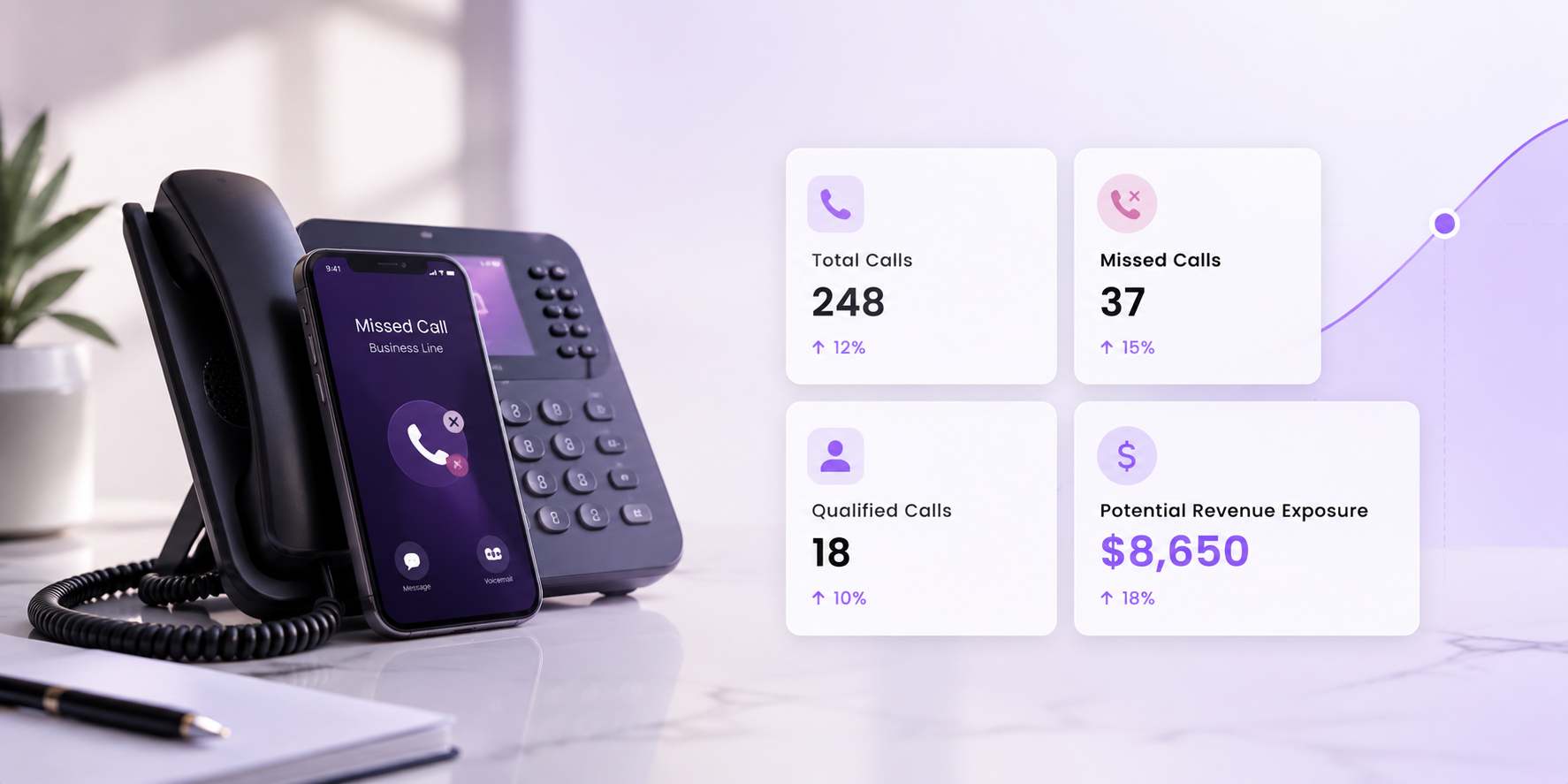
Your phone rings, but nobody answers. What did that missed call actually cost your business?
The most accurate answer is not $100, $500, or $1,000. You cannot know until you understand who called and what would probably have happened if the call had been answered.
Some missed calls are spam. Others are existing customers asking routine questions. Some callers leave a voicemail and are successfully contacted later. Others are potential customers looking for a quote, appointment, consultation, reservation, or urgent service.
Those calls clearly do not have the same business value. That is why there is no responsible universal dollar amount you can assign to every missed business call.
Instead, the useful question is: how much potential revenue is exposed when valuable calls go unanswered and are not successfully recovered?
This guide gives you a practical way to calculate that using your own call data rather than relying on generic industry averages.
What Is the Cost of a Missed Call?
The cost of a missed call is the potential business value associated with an unanswered inbound call that is not successfully recovered through voicemail, callback, online booking, another contact channel, or another follow-up process. A missed call does not automatically equal lost revenue because caller intent, conversion probability, customer value, and recovery all affect the outcome.
That distinction matters. If your business misses 50 calls in a month, you should not simply multiply 50 by your average job value and label the result “lost revenue.”
A more useful calculation starts by identifying how many missed calls were genuine business opportunities, how many of those callers would realistically have converted, what a converted customer is worth, and how many missed callers were successfully recovered afterward.
The Simple Missed-Call Cost Formula
If you already know how many missed calls were genuine opportunities, you can start with a simple formula:
Potential revenue exposure = Qualified missed calls × Expected conversion rate × Average customer value
For example, suppose your business had 20 qualified missed calls during the month, typically converts 25% of qualified phone enquiries, and has an average customer value of $500.
The calculation would be:
20 × 25% × $500 = $2,500
That gives you approximately $2,500 in potential revenue exposure.
It does not mean the business definitely lost $2,500. Some callers may have called again, left a voicemail, submitted a form, booked online, been contacted successfully later, decided not to buy, or chosen another provider.
The purpose of the calculation is to estimate what was at risk, not to pretend every unanswered call became lost revenue.
Don't Know Your Qualified Missed Calls? Start Here
Many small businesses do not already know how many missed calls represented genuine customer opportunities. In that case, build the calculation in stages.
Step 1: Find Your Total Inbound Call Volume
Start with the number of incoming business calls during a typical month. Depending on your setup, you may be able to find this information in your business phone system, VoIP dashboard, call logs, CRM, call-tracking platform, or mobile phone records.
Suppose your business receives 400 inbound calls per month.
That gives you the starting point for the rest of the calculation.
Step 2: Calculate Your Missed-Call Rate
Your missed-call rate tells you what percentage of inbound calls go unanswered.
Use this formula:
Missed-call rate = Missed calls ÷ Total inbound calls × 100
If you received 400 calls and missed 48 of them:
48 ÷ 400 × 100 = 12%
Your missed-call rate is 12%.
That tells you there is an answering gap, but it still does not tell you how financially important those calls were.
Step 3: Separate High-Intent Calls From Low-Value Calls
The next step is to review the missed calls and classify them by intent.
Some calls may have little or no commercial value, including spam, robocalls, wrong numbers, vendor solicitation, and irrelevant enquiries.
Other calls may come from existing customers asking about business hours, directions, order status, general questions, or non-urgent support. These calls still matter to customer experience, but they should not automatically be treated as lost new revenue.
The calls that matter most for your revenue calculation are genuine commercial opportunities, such as new service requests, quote requests, appointment enquiries, consultation requests, reservations, new-client intake, product availability questions, or other potential sales enquiries.
Suppose that after reviewing the 48 missed calls, you determine that 24 were genuine new-customer opportunities. Your qualified missed calls = 24.
Step 4: Use a Realistic Conversion Rate
Next, estimate how many of those qualified callers would realistically have become customers.
Use your own historical conversion data whenever possible. If your business normally converts around 25% of qualified phone enquiries, then:
24 × 25% = 6 potential customers
This is still an estimate, but it is much more defensible than assuming all 24 callers would have purchased.
Step 5: Add Your Average Customer Value
Now apply a customer value that makes sense for your business. Depending on the type of company, that could mean average first transaction value, average service job, average appointment value, average reservation value, average signed engagement, or average first-year customer value.
The important thing is to use a consistent measure.
If your average first transaction is $450:
6 potential customers × $450 = $2,700
Your estimated monthly revenue exposure is therefore $2,700.
Again, that is not guaranteed lost revenue. It is the approximate value associated with qualified missed-call opportunities before accounting for recovery.
A Full Missed-Call Cost Example
Consider a hypothetical small service business that receives 400 inbound calls per month and misses 48 of them. That gives the business a 12% missed-call rate.
After reviewing those 48 calls, the business determines that 24 were genuine potential new-customer opportunities. Its historical data suggests that approximately 25% of qualified phone enquiries become customers, and its average first transaction is worth $450.
The calculation is:
24 qualified missed calls × 25% conversion rate × $450 average value = $2,700
The business therefore has approximately $2,700 in monthly potential revenue exposure associated with qualified missed calls.
But that is still not the end of the calculation. The next question is whether some of those callers were successfully recovered later.
The More Accurate Formula: Include Callback Recovery
A business with a reliable callback process has a very different missed-call problem from a business that never follows up.
Suppose the business had 24 qualified missed calls but later reconnected with 10 of those callers and successfully handled their requests. Those recovered calls should not automatically remain in the exposure calculation.
A more accurate formula is:
Unrecovered qualified missed calls × Expected conversion rate × Average customer value = Unrecovered revenue exposure
Using the same example, suppose there were 24 qualified missed calls, 10 were successfully recovered, and 14 remained unrecovered. With a 25% expected conversion rate and $450 average customer value:
14 × 25% × $450 = $1,575
Now the business has a more useful number: approximately $1,575 in potential monthly revenue exposure from unrecovered high-intent calls.
That is much more meaningful than simply saying, “We missed 48 calls and lost $21,600.”
A Missed Call Is Not Always a Revenue Problem
Some missed calls create operational cost even when they do not create immediate lost revenue.
Imagine an existing customer calls and nobody answers. They leave a voicemail. An employee later listens to it, writes down the information, calls the customer back, gets no answer, tries again, and eventually receives another incoming call from the same customer while handling something else.
No sale was necessarily lost, but the business still created additional administrative work.
That means missed calls can create two different types of cost.
Revenue exposure occurs when potential customers are not handled effectively and the opportunity may not convert.
Operational cost comes from staff time spent checking voicemail, returning calls, repeating information, tracking down callers, re-entering details, rescheduling, or managing follow-up that could have been handled more efficiently.
For some businesses, this operational burden can be almost as important as the potential sales impact.
When Are Missed Calls Most Expensive?
Not every unanswered call deserves the same priority. The business risk tends to increase when several factors are present at the same time.
The Caller Has High Intent
A caller asking, “Can you come today?” is commercially different from someone asking, “What time do you open?”
Both calls deserve appropriate handling, but the first is more likely to represent an immediate revenue opportunity.
The Customer Has Several Alternatives
If a potential customer can easily contact several competing businesses, waiting for a callback may be less attractive than continuing their search.
That does not mean every missed caller immediately chooses a competitor. It does mean businesses should consider how easy it is for the customer to find an alternative.
The Request Is Time-Sensitive
Urgent home-service requests, same-day appointments, last-minute availability, reservations, and time-sensitive sales enquiries may lose value quickly if nobody responds.
The appropriate definition of “urgent” will vary by industry and should be based on the business's actual operating rules.
The Call Happens After Hours
A customer who calls at 8:30 PM may receive no response until the next morning unless the business has a defined after-hours workflow.
Businesses dealing with this regularly should also review the different options for after-hours phone answering for small businesses, including voicemail, forwarding, live answering, AI receptionists, and hybrid coverage.
The Business Has No Recovery Process
A missed call becomes more concerning when nobody clearly owns the follow-up.
A structured callback process can recover opportunities. An unmonitored voicemail box cannot.
How Missed-Call Economics Change by Industry
The calculation framework remains broadly the same across industries, but the numbers and types of calls can vary significantly.
Home Services
Home-service businesses may receive calls for repairs, quotes, scheduled maintenance, availability questions, or urgent service.
Customer value can vary substantially depending on the job, which is why one average figure rarely tells the full story. For a vertical-specific example, see our breakdown of how much a missed plumbing call may cost.
Appointment-Based Businesses
For salons, clinics, wellness businesses, and other appointment-driven companies, missed calls may involve new bookings, rescheduling, availability questions, or service enquiries.
In these businesses, average appointment value and booking conversion rate may be more useful inputs than long-term customer value.
Professional Services
A law firm, consultancy, real-estate business, accounting firm, or other professional service may receive fewer calls but potentially higher-value enquiries.
That means raw call volume can be misleading. Twenty low-intent missed calls in one business may matter less financially than three high-intent missed calls in another.
Restaurants and Hospitality
Phone calls may involve reservations, group bookings, availability, event enquiries, or guest questions.
The value of the call can vary depending on party size, booking type, timing, and whether the customer has another way to complete the transaction.
This is why generic “average missed-call value” figures across industries should be treated cautiously.
Audit Your Missed Calls Before Buying Anything
If you suspect missed calls are costing the business money, do not immediately assume the answer is another employee, a new answering service, or automation.
First, audit the calls.
Review at least 30 days of inbound activity and record total calls, answered calls, missed calls, the time and day each missed call occurred, whether it happened during business hours or after hours, caller intent, whether the caller was a prospect or existing customer, whether voicemail was left, whether a callback was attempted, whether the caller responded, and the final outcome where it can reasonably be determined.
The patterns are often more useful than the raw missed-call number. You may discover that calls are missed mainly during lunch, while employees are serving customers, when field staff are on-site, when multiple callers arrive at once, after closing, during seasonal peaks, or on weekends.
Each pattern points toward a different solution.
What Should You Fix First?
Once you understand why calls are being missed, match the solution to the actual operational problem.
If Nobody Clearly Owns the Phone
Clarify responsibility and coverage first. The business may not need additional technology if the underlying issue is simply unclear ownership.
If Slow Callbacks Are the Main Problem
Create a defined missed-call recovery process with a clear owner and expected response window. Better follow-up may recover a significant portion of missed opportunities.
If Calls Arrive After Hours
Consider an after-hours workflow using voicemail, online booking, call forwarding, on-call coverage, a live answering service, an AI receptionist, or a hybrid of multiple options.
If Staff Are Already Busy
Overflow coverage may be the more relevant solution. An employee serving an in-person customer should not necessarily need to interrupt that interaction whenever the phone rings.
If Most Calls Are Repetitive
Review whether routine questions, lead intake, qualification, appointment booking, or call routing can be handled more efficiently without requiring the same manual process every time.
If Many Calls Are Spam
Improving call screening and filtering may reduce the apparent missed-call problem without increasing answering capacity.
Where an AI Receptionist Fits
An AI receptionist is one possible solution to a missed-call problem, but it should not be the starting assumption.
It is most useful when a business has repeatable inbound-call workflows that can be clearly configured. These may include answering routine questions, capturing lead information, qualifying callers, booking appointments where the relevant workflow is configured, routing or transferring calls, handling after-hours enquiries, managing multiple inbound calls, generating call summaries, or filtering unwanted calls.
Rexpt is designed around these types of business call-handling workflows, including lead capture, appointment booking, routing, after-hours coverage, call summaries, and caller screening.
However, automation does not make unclear business processes clear. The business still needs to define which calls can be handled automatically, what information should be collected, which situations require a person, what happens if a transfer fails, what qualifies as urgent, who owns the follow-up, and what information the agent needs to handle the conversation correctly.
That configuration determines whether an automated answering system actually solves the missed-call problem.
Compare the Cost of the Problem With the Cost of the Solution
Once you have estimated your potential revenue exposure, compare it with the cost and operational effort required to improve coverage.
If your realistic unrecovered missed-call exposure is around $300 per month, hiring a full-time employee solely to solve that problem may not make economic sense. If the exposure is several thousand dollars per month and continues to grow, better call coverage may deserve more serious investment.
Possible solutions include improving staffing, faster callbacks, call forwarding, live answering services, AI receptionists, or hybrid coverage.
The important question is not simply, “How cheap is the answering solution?” It is, “Is the cost and effort of solving this problem reasonable relative to the problem we have actually measured?”
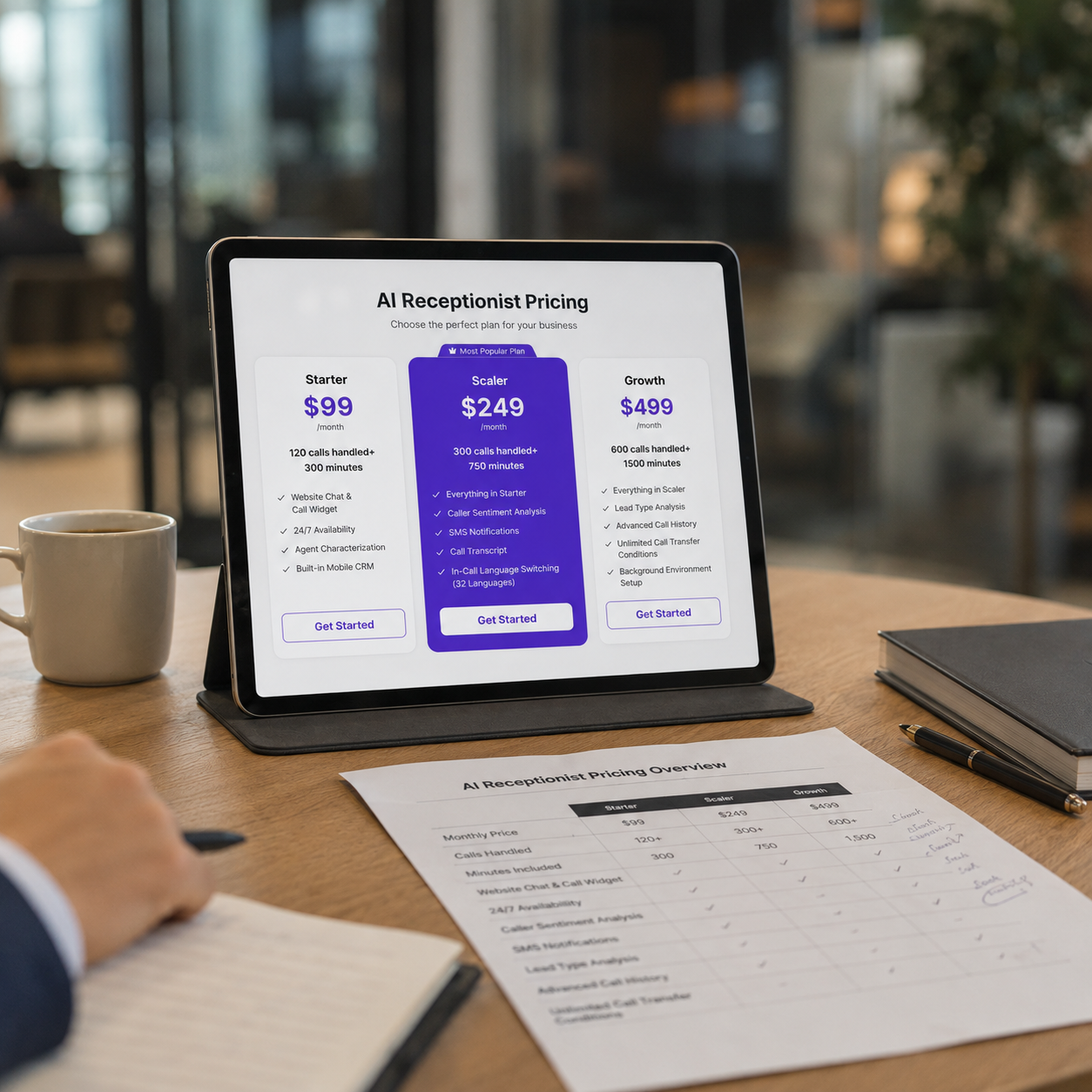
If you are comparing automation costs specifically, our AI receptionist pricing guide explains the main pricing models and cost factors to consider.
Your Missed-Call Audit Checklist
Before making a decision, make sure you can answer the following questions:
- How many inbound calls do we receive each month?
- How many go unanswered?
- What is our missed-call rate?
- When are most calls missed?
- How many missed calls are spam or irrelevant?
- How many are existing customers?
- How many are new prospects?
- How many represent genuine revenue opportunities?
- What percentage of qualified callers normally convert?
- What is our average customer value?
- How many missed callers are successfully recovered?
- How quickly do we call them back?
- Who owns that process?
- Which missed calls happen after hours?
- Which calls could be handled without a person?
- Which calls must reach a human?
- How much potential revenue exposure remains after recovery?
Once you can answer those questions, you have something far more useful than a generic industry statistic: your own missed-call economics.
The Number That Matters Is Your Number
There is no universal answer to the question, “How much does a missed call cost a small business?”
A missed call could be spam. It could create a minor customer-service inconvenience. It could be successfully recovered five minutes later. Or it could represent a valuable sales opportunity that never receives a response.
The useful way to evaluate the problem is to measure how many calls you miss, who those callers are, what they wanted, how many are successfully recovered, and what a realistic conversion is worth.
Once you know that, you can decide whether the right response is better staffing, faster callbacks, voicemail, call forwarding, a live answering service, an AI receptionist, or a combination of approaches.
The goal is not to eliminate every missed call at any cost. It is to understand which calls matter enough that missing them becomes an expensive business problem.
Frequently Asked Questions
How much does one missed call cost a small business?

There is no universal amount. The cost depends on what the caller wanted, how likely they were to become a customer, the value of that customer, and whether the business successfully followed up later.
How do you calculate the cost of missed calls?

A simple starting formula is: Qualified missed calls × Expected conversion rate × Average customer value = Potential revenue exposure. For a more accurate estimate, remove callers who were successfully recovered through callbacks or another channel.
Does every missed call mean lost revenue?
No. Some missed calls are spam, wrong numbers, existing-customer questions, or callers who reconnect later. Only some unanswered calls represent unrecovered revenue opportunities.
Why do small businesses miss customer calls?
Common reasons include staff serving customers, employees working in the field, multiple calls arriving at once, after-hours enquiries, seasonal peaks, staffing gaps, and unclear responsibility for answering or following up.
Can an AI receptionist help reduce missed calls?
Yes, when the business has repeatable call workflows. An AI receptionist can help answer routine questions, capture lead information, handle after-hours enquiries, book appointments where configured, route calls, and escalate situations that require a person.
On this page
- What Is the Cost of a Missed Call?
- The Simple Missed-Call Cost Formula
- Don't Know Your Qualified Missed Calls? Start Here
- A Full Missed-Call Cost Example
- The More Accurate Formula: Include Callback Recovery
- A Missed Call Is Not Always a Revenue Problem
- When Are Missed Calls Most Expensive?
- How Missed-Call Economics Change by Industry
- Audit Your Missed Calls Before Buying Anything
- What Should You Fix First?
- Where an AI Receptionist Fits
- Compare the Cost of the Problem With the Cost of the Solution
- Your Missed-Call Audit Checklist
- The Number That Matters Is Your Number
- Frequently Asked Questions
Stop missing
customer calls.
Rexpt answers calls, qualifies leads, and books appointments 24/7.